
Why an AI Chatbot Can’t Replace a Systematic Literature Review — and What It Can Do
In a world where AI is evolving rapidly, one question keeps coming up in healthcare, especially in evidence generation and market access: “Can an AI chatbot replace a systematic literature review (SLR)?” As the founder of Oncoscope-AI, a platform focused on transforming how we track and synthesize oncology evidence, my answer is simple: No — not even close. But there’s a much more important follow-up: AI can fundamentally transform how SLRs are built, maintained, and used — if we apply it the right way. Why SLRs Are Still the Gold Standard Systematic literature reviews are foundational tools in evidence-based medicine. They are methodologically rigorous, reproducible, and transparent — all critical features when informing high-stakes decisions in drug development, health technology assessments (HTAs), clinical guidelines, and reimbursement. A well-conducted SLR isn’t just a literature search. It’s a structured, protocol-driven process governed by frameworks like PRISMA, Cochrane, or GRADE. It includes clear inclusion/exclusion criteria, detailed documentation of search strategies, dual reviewer consensus, and often a meta-analysis. In short: SLRs build trust — because the process is as important as the outcome. Where AI Chatbots Fall Short While chatbots like ChatGPT, OpenEvidence, Perplexity, or other LLM-based tools can sound authoritative and answer questions quickly, they have significant limitations when it comes to replacing SLRs. These characteristics make them fundamentally incompatible with the standards required in clinical research, regulatory decision-making, or payer engagement. What AI Can Do for Evidence Synthesis While chatbots can’t replace SLRs, AI can absolutely enhance the way SLRs are performed, maintained, and consumed. This is the space we are focused on at Oncoscope-AI. Here’s how: 1. Real-Time Monitoring of New EvidenceAI can continuously scan new publications, clinical trial databases, regulatory announcements, and guideline updates — surfacing relevant changes in near real-time. 2. Efficient Screening and CategorizationAI can rapidly identify and classify articles based on criteria defined in a protocol, dramatically reducing the manual burden on human reviewers. At Oncoscope, we trained and validated AI programs to deliver over 99% accuracy for this task – with details on rejections well beyond what humans are used to provide. 3. Smarter Data ExtractionWhile AI can’t yet extract all types of data reliably, there are many variables where it already performs as well as — or even better than — humans. At Oncoscope, we carefully evaluate each type of data we need to extract, and we implement AI selectively and responsibly. The rule of thumb we follow is: if you can standardize it, you can automate it. Structured variables can often be automated — freeing our experts to focus on the more complex and nuanced interpretation. 4. Version Control and Living UpdatesTraditional SLRs are static snapshots. At Oncoscope, we’re enabling “Living SLRs” — always current, always linked to their sources, and always grounded in rigorous methods. 5. Actionable Summaries Without Compromising RigorUsing AI for extraction and summarization doesn’t mean cutting corners. It means scaling expertise, speeding updates, and freeing time for deeper interpretation. Our Vision at Oncoscope-AI We are not building another chatbot. We are building an evidence engine that understands how oncology evolves — one that stays current without sacrificing standards. Our platform continuously tracks: All of this is structured, sourced, and updated in real time — providing oncologists and other healthcare professionals with a living map of the oncology evidence landscape. In short, we’re bringing the structure of an SLR and the speed of AI together — without compromising either. Final Thoughts So, can an AI chatbot replace a systematic literature review? No — and it shouldn’t. But AI, when designed for evidence integrity and real-world utility, can transform what an SLR can become. This transformation is no longer hypothetical. It’s happening now — and we’re proud to be leading it at Oncoscope-AI. Interested in how a Living SLR can support your work in oncology or market access? Let’s connect.📩 info@oncoscope-ai.com | LinkedIn Anna Forsythe is the Founder and President of Oncoscope-AI, the first platform to bring together real-time oncology treatment data, clinical guidelines, research publications, and regulatory approvals — all in one place, just like Expedia for cancer care. Available free to oncology professionals worldwide, Oncoscope-AI is redefining how cancer care information is accessed and applied. A clinically trained Doctor of Pharmacy (PharmD), Anna also holds a Master’s in Health Economics and Policy from the University of Birmingham (UK) and an MBA from Columbia University. She previously co-founded Purple Squirrel Economics (acquired by Cytel in 2020) and led Global Value and Access at Eisai Pharmaceuticals, following earlier roles at Novartis and Bayer in clinical research and health economics.
New Features Now Live in v1.2!
Oncoscope continues to improve and evolve. Our latest update makes finding the clinical evidence you need – even if you aren’t sure what that is yet – even faster and easier.
The Effective Statistician Podcast: Daily Updated Systematic Literature Reviews – The Future of Oncology
Oncoscope-AI Founder & CEO Anna Forsythe was recently invited to be a guest on Dr. Alexander Schacht‘s “The Effective Statistician” podcast. Listen to the full episode on your podcast platform of choice! Spotify: Pocket Casts: Here’s what Dr. Schacht had to say: How can oncologists and healthcare professionals keep up with the ever-growing body of research to make the best decisions for patients? In this episode, I speak with Anna Forsythe, a pharmacologist, health economist, and founder of Oncoscope-AI, a groundbreaking platform delivering daily updated systematic literature reviews (SLRs) in oncology. Drawing on decades of experience in pharma and health economics, Anna shares how automation and AI are transforming the traditionally tedious SLR process—making up-to-date evidence accessible to clinicians in just a few clicks. Why You Should Listen: ✔ Discover how SLRs are evolving through automation and AI ✔ Learn how real-time data can improve cancer treatment decisions ✔ Understand the balance between innovation and clinical responsibility ✔ Hear about a tool that could change the way guidelines and clinical practice align ✔ Be inspired by a founder’s mission to create impact through altruistic innovation
Anna Forsythe Built Oncoscope to Give Doctors What They Actually Need: Usable Intelligence
In today’s healthcare landscape, oncologists are drowning in data. Thousands of studies are published each month, new FDA approvals roll out regularly, and guidelines change constantly. Yet, despite this flood of information, many doctors still struggle to make the best treatment decisions for their patients. The problem is not a lack of data. The problem is a lack of usable insights. Nowhere is this more critical than in oncology, where every day and every decision can change the course of a patient’s life. Anna Forsythe, founder of Oncoscope-AI, an AI-powered oncology intelligence platform, has spent her career at the intersection of science, economics, and clinical practice. She believes the answer is not to add more data to the pile but to transform it into clarity. “We do not need to give physicians more to read,” Forsythe says. “We need to give them the right information, in real-time, that is relevant to the patient in front of them.” It is a reasonable expectation, but one that the current system sometimes fails to meet. Oncology guidelines can span hundreds of pages, often outdated by the time they reach clinical use. “While there have been recent attempts to address this problem with a chatbot approach, it is the human/AI combination that is key in achieving usability and physicians’ trust.” Forsythe’s platform, Oncoscope, solves this challenge by merging human expertise with trained artificial intelligence. It automatically reviews and organizes clinical trials, cross-referencing them with regulatory approvals and treatment guidelines. The result is a curated, reliable, and immediately usable knowledge base that oncologists can access in seconds. It works like this: a doctor inputs three basic clinical parameters—the stage of the disease, the genetic profile, and any prior treatments. In return, they receive a tailored, human-reviewed list of relevant studies, including survival outcomes and progression data, with immediate links to guidelines, approvals, and original publications. There is no need to scroll through irrelevant abstracts or search multiple databases. Everything is in one place, organized and actionable. This kind of tool is not just a convenience. It is a necessity. According to Forsythe, she was inspired to create Oncoscope after seeing people in her own life receive outdated or suboptimal cancer treatments. In one case, a friend with late-stage breast cancer was placed on chemotherapy despite the existence of a newer, more targeted therapy. The doctor had not yet seen the recent study supporting it. Forsythe found it in three clicks. “That story is not an exception,” she says. “It is happening every day. And it is not because doctors are careless. It is because the information is not delivered in a way they can use quickly.” This is a systemic flaw, and it has consequences. When oncologists default to older treatments because they cannot keep up with new evidence, patients can miss out on therapies that could extend or improve their lives. In a field where even a few months of added survival can mean everything, delays in information are delays in care. Forsythe and her team designed Oncoscope to cut out these delays. The system prioritizes the most rigorous research, flagged for relevance and clinical significance. Each entry is reviewed by experts to ensure it meets regulatory-grade standards. Doctors are not asked to interpret raw data—they are given the insights they need to make decisions now. Critically, Oncoscope is free for verified healthcare professionals. Forsythe calls it an altruistic venture, at least for now. Her goal is simple—to give doctors a tool they can trust and patients the care they deserve. “If we want better outcomes in cancer care,” she says, “we do not need more information. We need smarter information. That is what changes lives.” Beka Vinogradov is the Digital Communications Lead for Oncoscope-AI. She holds a Master’s in Health Administration and has extensive experience and education in business, marketing, and design.
Oncoscope Officially Launches, Ushering in a New Era of Real-Time Oncology Intelligence
Oncoscope officially launches, offering real-time, powered by AI, oncology insights to doctors. Free for verified clinicians, it helps improve cancer treatment decisions in just three clicks. Oncoscope-AI, a revolutionary oncology intelligence platform, has officially launched following a successful beta phase and over a year of strategic development that involved extensive conversations with practicing oncologists. The platform, which delivers real-time, human-curated cancer insights enhanced by artificial intelligence, is now live and available free of charge to verified healthcare professionals worldwide. Founded by Anna Forsythe, a pharmacist, health economist, and seasoned pharmaceutical executive, Oncoscope addresses a critical gap in oncology care. It gives clinicians instant access to the most current treatment data, FDA approvals, and guideline-aligned information, consolidated into one user-friendly platform. “Doctors do not need more data. They need the right information, at the right time, in a format they can use to make better decisions for their patients,” said Forsythe. “Oncoscope provides that clarity. It is a living library of oncology, curated by experts and built to save lives.” Unlike generic AI tools or static databases, Oncoscope uses trained AI to scan thousands of oncology publications and filters them through a rigorous, evidence-based framework. Each entry is cross-referenced with clinical guidelines and regulatory approvals to ensure usability and relevance. All of the results are carefully scrutinized by a team of experienced researchers. Currently, the platform supports breast and lung cancer, with prostate, bladder, colon, and rectal modules rolling out in the coming months. The process is intuitive. Physicians answer three clinical questions—cancer stage, genetic markers, and prior treatments—and receive a personalized, actionable summary. Each recommended article includes survival data, progression insights, treatment efficacy, and toxicity, extracted across 32 key clinical parameters. “The result is something physicians can actually use in the moment,” said Forsythe. “It takes three clicks to go from a patient in the room to the most up-to-date evidence in the field.” Access to Oncoscope is free for verified healthcare professionals, including physicians, nurses, pharmacists, genetic counselors, and physician assistants. Non-verified users, such as those in finance or consulting, can purchase limited access at a monthly rate, restricted to a single cancer type. This structure reflects the company’s commitment to empowering front-line clinicians with better tools—without barriers. Forsythe, who previously founded and sold a successful health economics company serving global pharmaceutical clients, brings a rare combination of clinical, technical, and business expertise to this venture. She sees Oncoscope not only as a tool, but as a mission. “This platform was born from both professional insight and personal urgency,” she said. “Too many patients are still receiving outdated treatments, simply because their doctors do not have time to stay current. I realized I had the knowledge, the team, and the experience to fix that.” With a lean team, strategic vision, and a rapidly growing user base, Oncoscope is poised to become a trusted global resource in cancer treatment.“We are not just a tech company,” said Forsythe. “We are part of the oncology ecosystem. And we are here to help doctors deliver the best care possible.” Beka Vinogradov is the Digital Communications Lead for Oncoscope-AI. She holds a Master’s in Health Administration and has extensive experience and education in business, marketing, and design.
Founder Spotlight: Anna Forsythe, PharmD — Bringing Clarity to the Chaotic and Rapid Data Influx in Oncology with Oncoscope AI
As seen in Oncologist Daily, ASCO 2025 Edition The pace of progress in oncology is both exhilarating and overwhelming. New clinical trials, biomarkers, FDA approvals, and updated guidelines appear almost daily, creating a deluge of information that even the most diligent oncologists struggle to absorb. For Anna Forsythe, who had lost two good friends to cancer — and who is trying to help a third with a difficult diagnosis — this was more than just a challenge. It was a call to action. As the founder of Oncoscope AI, Anna has set out to build what she calls “a GPS for oncology.” Much like a car navigation system that recalculates routes in real time based on constantly changing traffic patterns, Oncoscope AI continuously updates to reflect the latest evidence — synthesizing and collating research data, treatment guidelines and regulatory approvals into a single, streamlined view designed for oncologists to use in real time at the point of care. “Oncoscope doesn’t replace the physician’s judgment,” Forsythe explains. “It augments it — giving clinicians a clear, current, and unbiased and easy to use view of what’s changing in real time, so they can spend less time digging through papers and more time with their patients.” This balance of innovation and practicality reflects Anna’s own background. A clinically trained Doctor of Pharmacy, she holds a Master’s Degree in Health Economics and Policy from the University of Birmingham (UK) and an MBA from Columbia University. Her career spans both the clinical and strategic sides of the pharmaceutical industry — with leadership in both oncology and non-oncology roles roles in global value and access at Eisai Co., and earlier positions at Novartis and Bayer in clinical research and health economics. She’s no stranger to entrepreneurship either. Anna previously co-founded Purple Squirrel Economics, a health economics consultancy that was acquired by Cytel, the Cambridge, Massachusetts-based statistical software developer and contract research organization, in 2020. Her work has appeared in leading journals and conference podiums alike, including a top-ranked JAMA Pediatrics article, which placed in the top 5 percent of all JAMA research outputs worldwide. But it’s Oncoscope that brings her experiences full circle — combining clinical insight, economic acumen, and a passion for scalable solutions that work in real-world oncology settings. As thousands of oncologists gather at ASCO 2025 to digest the latest data and translate it into better care, Oncoscope AI offers a timely reminder that innovation doesn’t have to be overwhelming — if it’s built from the ground up with the physician in mind. “We’re not a technology in search of an application — and we’re not at all suggesting that oncologists change how they practice,” says Forsythe. “They are the experts. We are merely helping them by building a tool that fits seamlessly into their reality — one that helps them keep up with the latest information, and communicate the most up-to-date strategies clearly with patients. The goal is to help them stay focused on what matters most: delivering the best possible care.” With Oncoscope AI, Anna Forsythe is leading a new kind of precision oncology — one where evidence and empathy meet at the bedside, powered by smart, real-time technology. Anna Forsythe is the Founder and President of Oncoscope-AI, the first platform to bring together real-time oncology treatment data, clinical guidelines, research publications, and regulatory approvals — all in one place, just like Expedia for cancer care. Available free to oncology professionals worldwide, Oncoscope-AI is redefining how cancer care information is accessed and applied. A clinically trained Doctor of Pharmacy (PharmD), Anna also holds a Master’s in Health Economics and Policy from the University of Birmingham (UK) and an MBA from Columbia University. She previously co-founded Purple Squirrel Economics (acquired by Cytel in 2020) and led Global Value and Access at Eisai Pharmaceuticals, following earlier roles at Novartis and Bayer in clinical research and health economics.
Saving Lives in Real Time: Why Oncology Must Embrace AI, but Carefully
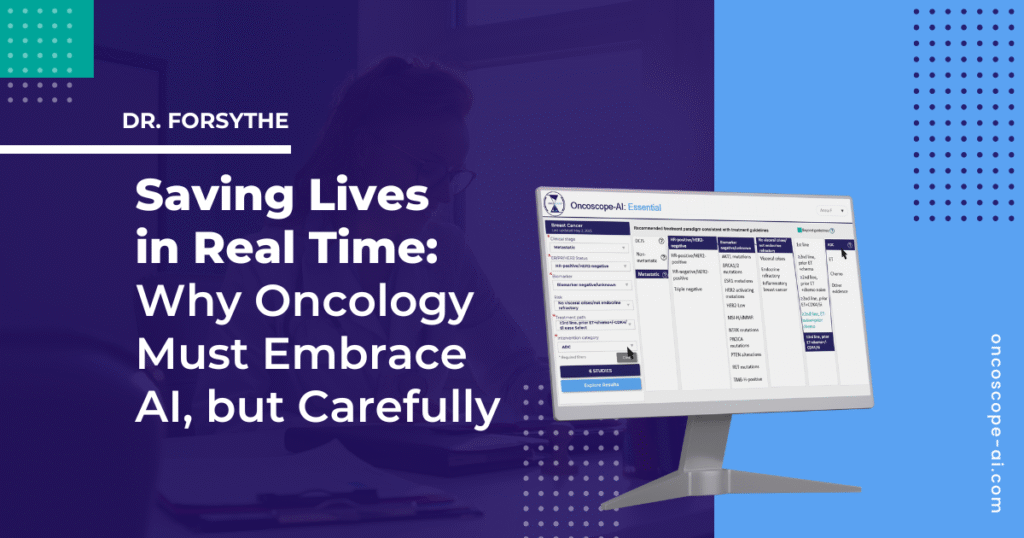
In January, my close friend Susan received devastating news: after six long years of navigating chemotherapy, surgery, radiation, and a targeted therapy that had finally given her back her quality of life, her breast cancer had returned, this time to her liver. She was terrified, not just of the disease, but of what might come next. “I just don’t want to go through chemo again,” she said, fighting back tears. “Is there anything new?” Her oncologist, she said, was excellent. But like so many today, he was overwhelmed. She feared he wouldn’t have time to search for new options that might have emerged in recent months. As a health economist, I’ve spent years sifting through research and data, and I knew that finding up-to-date, reliable information shouldn’t depend on how many hours a doctor can spare after a crushing workload serving patients in the clinic. The mountain of data is overwhelming to even the most dedicated physician trying to keep up. In 2024 alone, over 4,800 papers were published describing breast cancer clinical trials. In the first three months of 2025, another 860 have already appeared. Meanwhile, headlines everywhere tout artificial intelligence (AI) as a revolutionary force in healthcare. But wise physicians and patients alike know the truth: while AI’s potential is enormous, its safe and meaningful application demands careful human oversight, clinical rigor, and a deep understanding of what is at stake. That’s why I turned to a new kind of tool—an AI system specifically designed for medicine, rigorously vetted by human experts, and built not just to gather data, but to curate it, critically evaluate it, and prioritize clinical relevance. Far beyond your average ChatGPT-style chatbot, the tool was a hybrid system: part artificial intelligence, part human expertise. Behind the scenes, it performed a systematic review of the latest literature, flagged high-quality clinical trials, and filtered out unreliable data, creating a curated, searchable database of real, actionable evidence. Within minutes, this hybrid AI-human platform helped me discover a promising new class of drugs—antibody-drug conjugates or ADCs. These therapies target chemotherapy precisely to cancer cells, sparing healthy tissue and potentially reducing side effects. One ADC had just demonstrated outstanding results in a major clinical trial—results so recent they hadn’t yet made it into official treatment guidelines. Susan shared this information with her oncologist. After reviewing the evidence, he agreed. Today, she is on the new therapy—and planning her next vacation. As Dr. Mehran Habibi, a leading breast cancer surgical oncologist in New York, put it to me recently: “AI can’t replace clinical judgment—but it can support it. The only way physicians will trust these tools is if they know the science behind them has been vetted by humans who understand the stakes.” What’s striking isn’t just the speed with which this information was uncovered, but the fact that it could so easily have been missed, he said. “While oncologists are expected to stay on top of a constantly evolving field, the guidelines they depend on, produced by expert committees, are updated infrequently, and, despite the best of intentions, are not immune to biases or conflicts of interest. Additionally, tools like ChatGPT, while popular, can’t be trusted to provide rigorously sourced, clinically relevant information. They’re prone to consider misinformation and half-truths rampant on the internet, and often present content that is incomplete, outdated, or based on opinion rather than evidence.” ChatGPT and other apps that utilize AI are powerful tools in many fields, but not necessarily for clinical science, which demands the highest rigorous standards to be useful to oncologists, he continued. “We don’t rely on GPS apps that guess which roads exist — we expect accuracy and live updates. We don’t book flights through websites that suggest destinations based on personal blogs instead of real availability. So why would we accept anything less in cancer care?” The future of oncology demands “living guidelines”—dynamic, continuously updated frameworks that reflect the latest discoveries, not just a data-dump collected over the last 12 months. That’s what this new class of AI/human tools can enable. They don’t replace the physician. They equip them. And that’s the real power of this approach: it can free up doctors to spend more time with their patients, not less. AI/human tools can support medical education, help residents prepare for board exams, and enhance shared decision-making by providing clear, visual explanations of treatment paths. Susan’s story has a hopeful turn. But there are countless others who may not be as lucky unless we rethink how we connect patients to the best and latest therapies. The race between cancer and medicine is relentless. It’s time we give our doctors the tools to win it. Not because they make decisions for us, but because they make it easier to find the right ones. Anna Forsythe is the Founder and President of Oncoscope-AI, the first platform to bring together real-time oncology treatment data, clinical guidelines, research publications, and regulatory approvals — all in one place, just like Expedia for cancer care. Available free to oncology professionals worldwide, Oncoscope-AI is redefining how cancer care information is accessed and applied. A clinically trained Doctor of Pharmacy (PharmD), Anna also holds a Master’s in Health Economics and Policy from the University of Birmingham (UK) and an MBA from Columbia University. She previously co-founded Purple Squirrel Economics (acquired by Cytel in 2020) and led Global Value and Access at Eisai Pharmaceuticals, following earlier roles at Novartis and Bayer in clinical research and health economics.
Clinicians Don’t Need More Data, They Need Usable Insights
In oncology, where time is critical and treatment paths are complex, clear and timely communication with patients isn’t a “nice to have,” it’s essential. In this short video, Chad Levitt highlights a core challenge in cancer care: when oncologists have to spend valuable time interpreting dense data, it delays the clarity patients need. The reality is, clinicians aren’t just looking for more information; they’re looking for usable information. Tools like Oncoscope-AI are designed with this in mind, delivering real-time oncology data that’s already filtered, prioritized, and clinically relevant. That means faster decision-making, clearer communication with patients, and a better care experience at one of the most critical moments in someone’s life. Because when we streamline the way doctors access and interpret clinical evidence, we ultimately serve the person who matters most: the patient. Beka Vinogradov is the Digital Communications Lead for Oncoscope-AI. She holds a Master’s in Health Administration and has extensive experience and education in business, marketing, and design.