
Pharma’s Biggest Missed AI Opportunity Is Living Evidence
This article was originally published by Anna Forsythe in Forbes on 29 January 2026. At this year’s J.P. Morgan Healthcare Conference, the largest healthcare investment symposium in the industry, it is no surprise that artificial intelligence featured prominently across a wide range of discussions from drug discovery, target identification and molecule design to clinical trial optimization and operational efficiency. AI applications are now fully embedded in each of these core pharmaceutical R&D strategies. What was far less visible, however, was the role AI could play in the systematic evaluation of scientific literature that underpins nearly every strategic, regulatory and reimbursement decision in modern pharma—or evidence generation. This omission is notable, in fact critical, at a time when AI-assisted evidence generation represents one of the industry’s most immediate and measurable opportunities for return on AI investment. Where AI Is Being Applied Today Current AI adoption in pharma tends to focus on highly visible areas closely associated with innovation, such as accelerating discovery timelines, improving trial execution and supporting internal productivity. These use cases already demonstrate long-term value and competitive differentiation. Still, the majority of high-stakes decisions in pharma do not hinge on discovery algorithms alone. Instead, they depend, as they have for decades, on structured assessments of existing evidence about disease burden and unmet need, historical endpoints and comparator performance, safety signals and evolving standards of care. These traditional assessments inform decisions ranging from trial design and asset valuation to regulatory strategy and pricing. Despite their importance, evidence workflows remain largely manual and highly fragmented. Navigating Using Outdated Maps A useful analogy is navigation. When trying to reach a destination, no one relies on an outdated static map (remember MapQuest?) printed years ago. Roads change, traffic patterns evolve and more efficient routes emerge constantly. Modern navigation relies on GPS systems that update continuously and reroute in real time. Pharma, however, still navigates critical decisions using static evidence reviews. Systematic Literature Reviews (SLRs), which have long been the gold standard for evidence synthesis, continue to be conducted as project-based exercises. This one-off approach is expensive and time-consuming, and the results are quickly outdated as new publications appear, guidelines are revised or new therapies enter the market. Once completed, these product-based exercises often live in disconnected siloes, requiring tweaking or partial reconstruction to support the next decision In a scientific environment that evolves daily, this reliance on static evidence is an increasingly poor and outdated solution, especially at a time when living, continuously updated maps offer a cost-effective solution. Increasing Regulatory And Reimbursement Pressure The limitations of static evidence are becoming more consequential as medical reimbursement systems evolve. In the United States, Medicare price negotiations are now in their third cycle under the Inflation Reduction Act. Medicare Part B drugs in oncology, for example, once largely insulated from pricing negotiations, are now fully in scope as of 2026. Manufacturers are expected to justify pricing not only based on evidence available at launch but also relative to new comparators and changing standards of care that continuously emerge over time. In Europe, the Joint Clinical Assessments (JCA), designed to create a unified, cross-national analysis of the efficacy of new drugs, raise needs and expectations further. Companies must consider all relevant comparators across all EU member states, address multiple subpopulations and present comprehensive, transparent evidence syntheses that can withstand scrutiny across multiple jurisdictions. In both settings, evidence is no longer assessed at a single point-in-time. At a time when regulatory and reimbursement demands are continuously being re-evaluated, conventional static snapshots struggle to keep pace with these demands as they evolve. The Cost Of Fragmentation Despite this pressure, evidence generation in pharma remains highly fragmented. Different functions (R&D, regulatory, health economics, market access, commercial) often commission their own literature reviews for similar questions. Reviews are modified, repeated and localized across regions, frequently by different external vendors and internal teams. Assumptions diverge. Institutional knowledge is lost. Redundancy accumulates. That redundancy is costly. A single high-quality SLR routinely costs six figures and takes months to complete. For global organizations with large portfolios, the cumulative cost of duplicated effort is substantial. More importantly, fragmented evidence increases the risk of inconsistency at moments when alignment matters most. Why General-Purpose AI Falls Short Generative AI tools like ChatGPT and chatbots are often cited as a solution. While useful for summarization or exploration, they are not designed to produce regulatory-grade evidence. Regulatory and reimbursement decisions require predefined methods, transparent inclusion criteria, traceable citations, reproducibility and alignment with established systematic review standards. Outputs must be auditable and defensible. General-purpose AI systems prioritize fluency over traceability and cannot replace structured evidence synthesis. In low-risk settings, speed may outweigh rigor. In regulated environments, rigor is non-negotiable. The Case For Living Evidence The alternative is a shift from static reviews to living evidence. A living evidence approach treats evidence as shared infrastructure rather than as a series of isolated projects. Evidence is continuously updated as new data emerges, centrally governed, and organized by indication, population, comparator and endpoint. Updates are incremental rather than repetitive, and changes are transparent. Functionally, this mirrors how GPS systems work: always current, responsive to new information and capable of supporting multiple routes and decisions from the same underlying map. Such an approach could support better decision-making across the product life cycle, reduce duplication and improve consistency under increasing regulatory and reimbursement scrutiny. Why The Shift Has Been Slow If the potential benefits are clear, why has adoption been limited? One reason is organizational structure. Evidence budgets are typically allocated by function, by brand and by project. Living evidence, by contrast, is shared longitudinally and is cross-functional. Adoption requires investment at an enterprise level rather than ownership by a single team. Living evidence is also, by its nature, less visible than discovery breakthroughs or novel technologies. Yet visibility and return are not the same. As AI continues to reshape pharma, the most impactful opportunities may lie not only in discovering new drugs faster, but in navigating the increasingly complex evidence landscape more intelligently. In an industry under growing pressure to
The Market Access Podcast: Will AI and Living Reviews Define the Next Era of Health Care Market Access?

Oncoscope-AI Founder & CEO Anna Forsythe was recently on the Market Access Podcast with Dr. Stefan Walzer to discuss how Living Systematic Literature Reviews (Living SLRs) are redefining evidence generation in oncology and beyond – highlighting the power of real-time updates, advanced automation, and the essential role of human insight. Traditional SLRs are static snapshots, while Living SLRs are real-time, dynamic, and AI-powered—delivering continuously updated insights crucial for life-or-death decisions and payer evaluations. Join this discussion as they explore the myth of AI chatbots as true decision support tools, the need for actionable data over summaries, and the future of evidence synthesis, clinical decision-making, and smarter market access. Listen on Spotify: Listen on YouTube: Listen on PocketCasts:
The Danger of Imperfect AI: Incomplete Results Can Steer Cancer Patients in the Wrong Direction
This article was originally published in International Business Times on 09 October 2025. Cancer patients cannot wait for us to perfect chatbots or AI systems. They need reliable solutions now—and not all chatbots, at least so far, are up to the task. I often think of the dedicated and overworked oncologists I have interviewed who find themselves drowning in an ever-expanding sea of data, genomics, imaging, treatment trials, side-effect profiles, and patient co-morbidities. No human can process all of that unaided. Many physicians, in an understandable and even laudable effort to stay afloat, are turning to AI chatbots, decision-support models, and clinical-data assistants to help make sense of it all. But in oncology, the stakes are too high for blind faith in black boxes. AI tools offer incredible promise for the future, and AI-augmented decision systems can improve accuracy. One integrated AI agent increased decision accuracy from 30.3% to 87.2% compared to the baseline of the GPT-4 model. Clinical decision AI systems in oncology already assist in treatment selection, prognosis estimates, and synthesizing patient data. In England, for example, an AI tool called “C the Signs” helped boost cancer detection in GP practices from 58.7% to 66.0%. These are encouraging steps. Anything below 100 percent is not enough when life is at stake. Cancer patients cannot afford to wait for us to resolve the issues these technologies still have. We risk something far worse than delay; we risk bad decisions born from incomplete, outdated, or altogether fabricated information. One of the worst issues is “AI hallucination.” These are cases where the AI has been found to present false information, invented studies, nonexistent anatomical structures, and incorrect treatment protocols. In one shocking example, Google’s health AI misdiagnosed damage to a “basilar ganglia,” an anatomical part that doesn’t exist. The confidently presented output looked authoritative until physicians recognized the error. Recent testing of six leading models, including OpenAI and Google’s Gemini, revealed just how unreliable these systems can be in medicine. They produced confident, step-by-step explanations that looked persuasive but were riddled with errors, ranging from incomplete logic to entirely fabricated conclusions. In oncology, where every patient is an outlier, that margin of error is unacceptable. Even specialized medical chatbots, which may sound authoritative, still present opaque and untraceable reasoning—their sources inconsistent, and their statistics often meaningless. This is decision distortion. The legal and ethical implications are real. If a treatment based on AI guidance causes harm, who is liable? The physician? The hospital? The AI developer? Medical-legal frameworks are scrambling to catch up, with some warning that overreliance on AI without human oversight could itself constitute negligence. The problem of AI hallucination extends beyond the medical realm. In the legal world, AI hallucinations have already led to serious consequences: in at least seven recent cases, courts disciplined lawyers for citing fake case law generated by AI. In one high-profile case, Morgan & Morgan attorneys were sanctioned after submitting motions containing bogus citations. If courts are demanding accountability for AI mistakes in law, how long before the medical malpractice lawsuits start being filed? In oncology, especially, reliance on AI amplifies risk because of how the tools are trained. Many large language models or decision systems depend on fixed journal cohorts or curated datasets. New oncology breakthroughs may remain outside that training collection for months or years. When we query such a system, it may omit the newest trial, ignore emerging biomarkers, or default to an outmoded standard of care. When AI invents studies or hallucinates efficacy, and doctors rely on it, patients pay the price. Moreover, cutting-edge medical data is often fragmented, diversified, and non-standardized; imaging formats differ, electronic health record notes are not uniform, and rare biomarkers may exist only in supplementary data. AI does best with well-structured, consistent data; it struggles with the disorder at the frontier of research. That means decisions about novel or borderline cases may be precisely where AI is least reliable. I’m not arguing that we scrap AI in cancer care. On the contrary, we must keep developing these tools, pushing boundaries, harnessing the power of computation to spot patterns no human sees. But we must not hand over ultimate decision-making authority to them, at least not yet. Cancer patients deserve better than experiments. They deserve human physicians who remain in the loop, who audit, challenge, and interrogate AI outputs. We need an architecture of human and AI collaboration. When a chatbot suggests a regimen, the oncologist should review supporting evidence, check for newly published trials, and confirm that the model’s assumptions match the patient’s specifics. The physician must own the decision. We can establish effective guardrails by implementing regular validation of AI systems with updated clinical data. By promoting transparency in training sources and mandating human review of all AI-suggested decisions, we can enhance overall trust in these technologies. Additionally, developing clear liability rules will help ensure accountability and foster responsible innovation. In practice, that means clinics deploying AI decision tools should monitor AI output, compare outcomes, run audits, and allow physicians to override or correct AI suggestions. We must also push for standardization of data, sharing across institutions, open and timely inclusion of new studies, and rigorous mechanisms to flag contradictions or hallucinations. Without that, the models will always lag the frontier. Cancer patients cannot wait for us to achieve AI perfection. But they deserve the best possible care now, and that requires that we never quit human responsibility in the name of speed. AI must serve as an assistant, not a dictator. Humans are in charge of deliberation and decision-making, and they must always prioritize caution when faced with unverified or ambiguous algorithms. AI chatbots are tools, not authorities. When we start letting algorithms decide instead of doctors, we have crossed from medicine into potential malpractice. Cancer patients don’t need perfect chatbots. They don’t have the time for the technology to catch up, and they cannot afford doctors who make decisions based on incomplete or outdated information. For patients and their families, the stakes are too high, and they deserve a much higher standard of
OncoDaily Interview: Could Oncoscope-AI Save Clinicians Hours – and Spare Patients Side Effects?
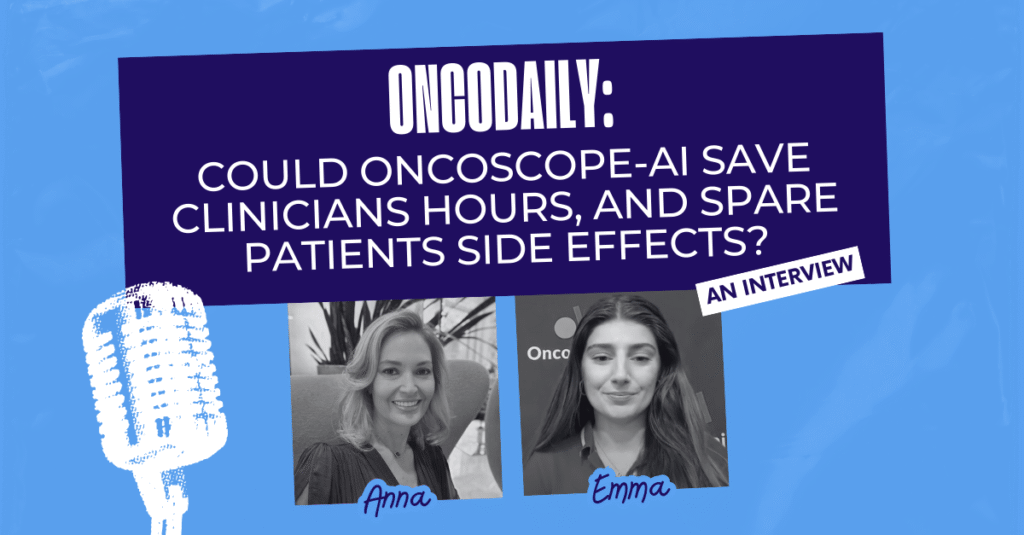
It’s good to talk about our 𝘄𝗵𝘆 sometimes. That’s why we appreciate Emma Ter-Azaryan’s interview so much. Not just for her insightful questions, but for giving us an opportunity to publicly reflect on 𝘄𝗵𝗮𝘁 𝗢𝗻𝗰𝗼𝘀𝗰𝗼𝗽𝗲-𝗔𝗜 𝗺𝗲𝗮𝗻𝘀 𝘁𝗼 𝘂𝘀. In this interview with OncoDaily, Oncoscope-AI Founder & CEO Anna Forsythe shares what drives her personally, an example of an oncologist using the tool and the impact it had, and the frustration of seeing people we love treated with chemotherapy because their doctors weren’t aware of updates in the guidelines and the research behind them. You can watch the full interview “Could Oncoscope-AI Save Clinicians Hours – and Spare Patients Side Effects?” here: From OncoDaily: In this episode of OncoDaily TV, host Emma Ter-Azaryan speaks with Anna Forsythe, CEO & Founder of Oncoscope-AI, to unpack how clinicians can cut through oncology’s data overload—FDA labels, guidelines, congress abstracts, and papers—and get to the right evidence in just a few clicks. What you’ll learn: ✅ What OncoScope AI is (in simple terms): a clinician-friendly “Expedia for evidence” that pulls from major medical databases, guidelines, regulatory updates, and congress outputs—cross-linked in one place.✅ Essential vs. Edge: two workflows—patient-first decision support vs. deep-dive topic exploration (e.g., ADCs in lung cancer, mutation-specific updates).✅ Power features: clickable disease maps, filter by congress (ASCO, World Lung, etc.), tumor-board prep, and one-click prior-auth reports with citations.✅ Real-world impact: how a brand-new FDA approval surfaced that week and helped a patient access a better-tolerated therapy sooner.”
From Cochrane To Chatbots: Why Evidence Matters Now More Than Ever In The AI Era
This article was originally published in Forbes on 02 September 2025. In oncology, discovery is moving at warp speed. Hundreds of new studies are published each week, sometimes more than a dozen in a single day. For patients and providers, this fire hose of information could equate to life-saving breakthroughs—a new biomarker, a novel dosing schedule or a survival-prolonging treatment. But it also equates to risk. Misinterpret a flawed trial, overtrust anecdotal experience or trust the wrong person, and patients are left at the mercy of ineffective or even harmful treatments. And so, as this deluge of data overwhelms us with such velocity, the imperative is ensuring that decisions are well-informed by precise, whole and transparent evidence. That all starts with one man: Archibald Leman Cochrane. Archibald Cochrane: The Original Evidence Disruptor Archibald Cochrane was a British physician and epidemiologist who served as a prisoner-of-war doctor in World War II. With effectively no medicines at his disposal, he watched patients suffer because care was based more on habit than proof. After the war, he became an outspoken advocate for a revolutionary principle: Medicine must be based on evidence that has been tested and proven, not on practice or expert opinion. In 1972, he published Effectiveness and Efficiency: Random Reflections on Health Services, a text that shook the medical establishment through criticism of its reliance on anecdotes. He argued that randomized controlled trials (RCTs) were required to determine whether treatments were effective and called for doctors and patients to be presented with objective summaries of all pertinent evidence. His vision inspired the Cochrane Collaboration, founded in 1993, which remains the global leader in producing systematic reviews. Pre-Cochrane, the concept of a controlled clinical trial did not exist. He was the one who established the use of controlled clinical trials, which have now become the gold standard for evaluating new treatments. Building On Solid Ground Cochrane’s work gave us the pyramid of evidence, often used to illustrate the hierarchy of reliability. The higher you climb in the pyramid, the stronger the foundation for life-and-death decisions. Why Systematic Reviews Save Lives In oncology, where treatment options evolve daily, systematic reviews are essential. A single study, whether positive or negative, rarely tells the full story. Systematic reviews, however, consider the entire body of evidence and account for consistency, quality and nuance. Nearly every modern guideline (from the World Health Organization to the FDA) requires systematic reviews as the foundation of clinical recommendations. These methods are necessary because lives depend on them. When Chatbots Pretend To Be Experts We’ve now entered the AI era, where large language models and chatbots can generate fluent answers to intricate medical questions in seconds. To overwhelmed oncologists confronting a deluge of literature, this might look like salvation. But these tools don’t follow the hierarchy of evidence. They don’t methodically scan all the studies, grade the quality of trials or reveal how they arrived at their conclusions. They generate responses based on text patterns that are sometimes accurate, sometimes incomplete and sometimes entirely fabricated. I’ve heard an example just last week from one of my medical colleagues: An AI tool produced a reference under his name for an article he had never written. It was a perfect illustration of how these systems behave like an overeager student desperate to provide an answer, even if that means inventing one. A chatbot’s “best guess” could mean proposing a treatment that introduces unnecessary toxicity to patients or worse, missing a well-documented new trial that would improve survival. The irony is that most of us would never hand over the task of booking a flight to a chatbot without carefully double-checking everything—the departure point, the destination city, the time of day. Yet somehow, when it comes to medical treatment, many are willing to accept incomplete or outdated chatbot outputs at face value. That disconnect should give us pause. Fluency Isn’t Truth One of the greatest risks of AI in medicine is that it sounds authoritative. Chatbots excel at fluency, but fluency is not the same as truth. At this time, AI simply isn’t ready for the weight we’re placing on it. Too many people are so captivated by what it can do that they forget the most basic principle of science and medicine. You must double-check the information. That fascination is dangerous. It encourages blind trust in answers that may be incomplete, misleading or outright wrong. If we allow fluency to masquerade as reliability, medicine risks sliding backward to the pre-Cochrane era, when anecdotes and authority carried more weight than solid data. Smarter Together I’m not saying that AI has no place in evidence-based medicine. Far from it. Let machines handle the tedious but essential work of scanning thousands of papers, formatting endless references and keeping reviews continuously updated as new trials are published. These are the repetitive housekeeping tasks that often slow researchers down, yet must be done with precision. I often compare it to household chores. AI should be doing the vacuuming so humans can spend their time on meaningful work. That’s exactly how my team approaches it. We’ve built a model that uses 36 different AI systems, integrated under the supervision of PhD-level experts, to make systematic reviews dramatically faster without compromising accuracy. Don’t outsource judgment to machines. Give human experts more bandwidth to do what only they can do: Interpret the evidence, weigh the nuances and make the right decisions for patients. Evidence Still Rules Cochrane warned half a century ago that a great deal of medicine lacked solid evidence. His admonition is even more urgent today. With AI, the danger is overconfidence in fluent machines that sound convincing but aren’t built on rigorous evidence. AI must serve evidence, not replace it. Healthcare leaders, policymakers and clinicians need to insist on transparency, rigor and comprehensiveness as absolute necessities. Because in oncology, and medicine in general, lives are at stake. And regardless of how much the tech advances, one thing will always be true: Evidence still rules. This article is
In the AI Era, Are Doctors Still at the Cutting Edge of Medicine? Oncoscope-AI Founder Anna Forsythe Asks
This article was originally published in Success Magazine. Artificial intelligence (AI) has revolutionized industries, from finance and logistics to advertising and agriculture. It has offered new efficiencies, insights and capabilities that were seemingly unimaginable just a few decades ago. Healthcare is no exception. In oncology, especially, where the volume of emerging research and the complexity of personalized treatments are accelerating, intelligent tools have become integral. Oncoscope-AI, an advanced oncology intelligence platform, was created to respond to this need. The catalyst behind the founding of the company was a profound question: How can AI help doctors keep up with and apply the flood of cancer breakthroughs to improve real-world patient care? The company has made answering that question its mission. Refining the approach to cancer treatment Anna Forsythe, founder of Oncoscope-AI, believes the cancer landscape today is vastly different from what it was 10 years ago. This is particularly evident in breast and lung cancer, two of the most commonly diagnosed cancers worldwide. “Before, a diagnosis of breast cancer meant a standard treatment regimen for nearly all patients. Individual biological differences didn’t matter. But our understanding has evolved,” Forsythe explains. Indeed, what was called “breast cancer” is now understood as multiple subtypes. Each has its own biological behavior, prognosis and treatment response. Similarly, lung cancer has splintered into a web of genetically and immunologically distinct conditions. The era of the one-size-fits-all approach, dominated by blanket chemotherapy, surgery and radiation, is fading. A more refined model of cancer treatment has emerged in its place. Forsythe states that today’s oncology is driven by two approaches. One is immunotherapy, which amplifies the body’s immune response to fight the disease from within. The other is targeted therapy, which focuses on specific biomarkers or genetic mutations within the tumor itself. They’re usually used in tandem with the goal of turning terminal-stage cancers into manageable, chronic conditions. Consider the arrival of CDK4/6 inhibitors palbociclib, ribociclib and abemaciclib and how they changed the landscape for breast cancer treatment. According to research based on trials, CDK4/6 inhibitors are considered revolutionary in breast cancer treatment and have played a key role in slowing progression. Progression-free survival, or how long a patient can live without the cancer worsening, has become the new benchmark of success. New challenges for physicians This progress introduces a new kind of pressure, however. “With every new biomarker discovered, every new targeted therapy or immunotherapy approved, the challenge for physicians multiplies,” Forsythe states. “How can any oncologist stay up to date with thousands of new studies, frequent regulatory updates and a deluge of clinical data?” At a single oncology conference, countless new abstracts may be released in just one cancer type. The expectation is that doctors will somehow process all of this while continuing to see patients, manage treatments and fulfill legal requirements for ongoing medical education. In theory, continuous medical education (CME) should help doctors stay current. In practice, it’s difficult for health professionals to retain all the information. Enter Oncoscope-AI Oncoscope-AI has emerged to empower healthcare professionals. Forsythe, a pharmacist, health economist and former pharmaceutical executive, designed it to bridge the divide between cutting-edge research and practical clinical application. The platform scans thousands of oncology publications using proprietary AI, filters them through an evidence-based framework and presents only the most clinically actionable insights. According to Oncoscope-AI, these findings are reviewed and contextualized by a human research team before being published in the system. The impact of Oncoscope-AI is best felt in patient stories. A friend Forsythe met while traveling was diagnosed with metastatic breast cancer. She had undergone traditional chemotherapy and surgery that left her physically and emotionally drained. “She was then prescribed one of the breakthrough CDK4/6 inhibitors. Her life changed. She regained energy, joy, and time,” Forsythe shares. However, when her cancer began to progress again, her oncologist defaulted to standard chemotherapy, believing there were no more options. There were. However, the doctor didn’t know. Forsythe sent her friend research summaries and articles through Oncoscope-AI, which she later shared with her doctor. She was then prescribed a new-generation therapy. “She’s thriving now,” says Forsythe. “She just returned from a trip to France and is booking another.” Aiming to help health professionals and patients thrive This story raises a question. How many more patients are out there who could live longer, better lives if only their doctors had access to the right information at the right time? “The problem is not the doctors. It’s the data overload,” Forsythe emphasizes. “The solution isn’t replacing physicians with AI, but equipping them with AI tools that distill noise into knowledge and confusion into clarity.” Oncoscope-AI is striving to do just that. It’s working to help oncologists across the globe turn the latest science into tangible outcomes for patients in the exam room, not months later when guidelines catch up. This article is for informational purposes only and does not substitute for professional medical advice. If you are seeking medical advice, diagnosis or treatment, please consult a medical professional or healthcare provider.
Oncoscope Officially Launches, Ushering in a New Era of Real-Time Oncology Intelligence
Oncoscope officially launches, offering real-time, powered by AI, oncology insights to doctors. Free for verified clinicians, it helps improve cancer treatment decisions in just three clicks. Oncoscope-AI, a revolutionary oncology intelligence platform, has officially launched following a successful beta phase and over a year of strategic development that involved extensive conversations with practicing oncologists. The platform, which delivers real-time, human-curated cancer insights enhanced by artificial intelligence, is now live and available free of charge to verified healthcare professionals worldwide. Founded by Anna Forsythe, a pharmacist, health economist, and seasoned pharmaceutical executive, Oncoscope addresses a critical gap in oncology care. It gives clinicians instant access to the most current treatment data, FDA approvals, and guideline-aligned information, consolidated into one user-friendly platform. “Doctors do not need more data. They need the right information, at the right time, in a format they can use to make better decisions for their patients,” said Forsythe. “Oncoscope provides that clarity. It is a living library of oncology, curated by experts and built to save lives.” Unlike generic AI tools or static databases, Oncoscope uses trained AI to scan thousands of oncology publications and filters them through a rigorous, evidence-based framework. Each entry is cross-referenced with clinical guidelines and regulatory approvals to ensure usability and relevance. All of the results are carefully scrutinized by a team of experienced researchers. Currently, the platform supports breast and lung cancer, with prostate, bladder, colon, and rectal modules rolling out in the coming months. The process is intuitive. Physicians answer three clinical questions—cancer stage, genetic markers, and prior treatments—and receive a personalized, actionable summary. Each recommended article includes survival data, progression insights, treatment efficacy, and toxicity, extracted across 32 key clinical parameters. “The result is something physicians can actually use in the moment,” said Forsythe. “It takes three clicks to go from a patient in the room to the most up-to-date evidence in the field.” Access to Oncoscope is free for verified healthcare professionals, including physicians, nurses, pharmacists, genetic counselors, and physician assistants. Non-verified users, such as those in finance or consulting, can purchase limited access at a monthly rate, restricted to a single cancer type. This structure reflects the company’s commitment to empowering front-line clinicians with better tools—without barriers. Forsythe, who previously founded and sold a successful health economics company serving global pharmaceutical clients, brings a rare combination of clinical, technical, and business expertise to this venture. She sees Oncoscope not only as a tool, but as a mission. “This platform was born from both professional insight and personal urgency,” she said. “Too many patients are still receiving outdated treatments, simply because their doctors do not have time to stay current. I realized I had the knowledge, the team, and the experience to fix that.” With a lean team, strategic vision, and a rapidly growing user base, Oncoscope is poised to become a trusted global resource in cancer treatment.“We are not just a tech company,” said Forsythe. “We are part of the oncology ecosystem. And we are here to help doctors deliver the best care possible.” Beka Vinogradov is the Digital Communications Lead for Oncoscope-AI. She holds a Master’s in Health Administration and has extensive experience and education in business, marketing, and design.
Founder Spotlight: Anna Forsythe, PharmD — Bringing Clarity to the Chaotic and Rapid Data Influx in Oncology with Oncoscope AI
As seen in Oncologist Daily, ASCO 2025 Edition The pace of progress in oncology is both exhilarating and overwhelming. New clinical trials, biomarkers, FDA approvals, and updated guidelines appear almost daily, creating a deluge of information that even the most diligent oncologists struggle to absorb. For Anna Forsythe, who had lost two good friends to cancer — and who is trying to help a third with a difficult diagnosis — this was more than just a challenge. It was a call to action. As the founder of Oncoscope AI, Anna has set out to build what she calls “a GPS for oncology.” Much like a car navigation system that recalculates routes in real time based on constantly changing traffic patterns, Oncoscope AI continuously updates to reflect the latest evidence — synthesizing and collating research data, treatment guidelines and regulatory approvals into a single, streamlined view designed for oncologists to use in real time at the point of care. “Oncoscope doesn’t replace the physician’s judgment,” Forsythe explains. “It augments it — giving clinicians a clear, current, and unbiased and easy to use view of what’s changing in real time, so they can spend less time digging through papers and more time with their patients.” This balance of innovation and practicality reflects Anna’s own background. A clinically trained Doctor of Pharmacy, she holds a Master’s Degree in Health Economics and Policy from the University of Birmingham (UK) and an MBA from Columbia University. Her career spans both the clinical and strategic sides of the pharmaceutical industry — with leadership in both oncology and non-oncology roles roles in global value and access at Eisai Co., and earlier positions at Novartis and Bayer in clinical research and health economics. She’s no stranger to entrepreneurship either. Anna previously co-founded Purple Squirrel Economics, a health economics consultancy that was acquired by Cytel, the Cambridge, Massachusetts-based statistical software developer and contract research organization, in 2020. Her work has appeared in leading journals and conference podiums alike, including a top-ranked JAMA Pediatrics article, which placed in the top 5 percent of all JAMA research outputs worldwide. But it’s Oncoscope that brings her experiences full circle — combining clinical insight, economic acumen, and a passion for scalable solutions that work in real-world oncology settings. As thousands of oncologists gather at ASCO 2025 to digest the latest data and translate it into better care, Oncoscope AI offers a timely reminder that innovation doesn’t have to be overwhelming — if it’s built from the ground up with the physician in mind. “We’re not a technology in search of an application — and we’re not at all suggesting that oncologists change how they practice,” says Forsythe. “They are the experts. We are merely helping them by building a tool that fits seamlessly into their reality — one that helps them keep up with the latest information, and communicate the most up-to-date strategies clearly with patients. The goal is to help them stay focused on what matters most: delivering the best possible care.” With Oncoscope AI, Anna Forsythe is leading a new kind of precision oncology — one where evidence and empathy meet at the bedside, powered by smart, real-time technology. Anna Forsythe is the Founder and President of Oncoscope-AI, the first platform to bring together real-time oncology treatment data, clinical guidelines, research publications, and regulatory approvals — all in one place, just like Expedia for cancer care. Available free to oncology professionals worldwide, Oncoscope-AI is redefining how cancer care information is accessed and applied. A clinically trained Doctor of Pharmacy (PharmD), Anna also holds a Master’s in Health Economics and Policy from the University of Birmingham (UK) and an MBA from Columbia University. She previously co-founded Purple Squirrel Economics (acquired by Cytel in 2020) and led Global Value and Access at Eisai Pharmaceuticals, following earlier roles at Novartis and Bayer in clinical research and health economics.