
Oncoscope-AI Launches Edge for Leaders Shaping the Next Standard of Cancer Care
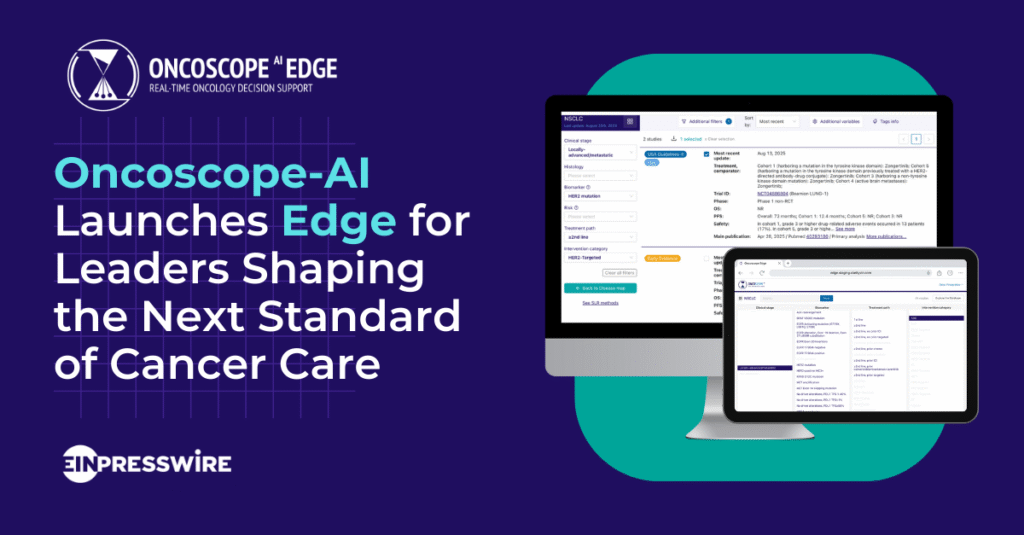
This press release was originally published to EINPresswire on 28 August 2025. NEW YORK, NY, UNITED STATES, August 28, 2025 /EINPresswire.com/ — Oncoscope-AI, a pioneer in real-time oncology evidence solutions, today announced the launch of Oncoscope Edge, a premium decision-support platform designed for oncology leaders and decision-makers who demand comprehensive, flexible, and actionable insights. In today’s fast-moving oncology landscape, specialists face an overwhelming volume of data—from thousands of new clinical trials to rapidly evolving guidelines and regulatory updates. Oncoscope Edge empowers oncologists, fellows-in-training, researchers, and educators with advanced tools to find, filter, and synthesize the evidence that matters most. “Oncoscope Edge is built for the leaders shaping the next standard of care,” said Anna Forsythe, PharmD, MBA, Founder and CEO of Oncoscope-AI. “Whether you are preparing for a congress talk, conducting a scientific project, guiding a tumor board, or training the next generation of oncologists, Edge delivers clarity from complexity—instantly.” Advanced Features of Oncoscope Edge include: With these capabilities, Oncoscope Edge goes beyond surface-level searches, available now in Oncology-AI’s Essential tool, to deliver deeper, customizable searches and user-generated reports—enabling oncology leaders to stay ahead in a field where evidence evolves daily. About Oncoscope-AI Oncoscope-AI is the first real-time oncology information platform integrating treatment data, guidelines, peer-reviewed publications, and regulatory approvals. By combining AI-powered systematic literature reviews with expert human validation, Oncoscope ensures that oncology decision-making is grounded in the most current and reliable evidence. Sign up for a free license key (verified health care professionals only) or to receive a demo.
Anna Forsythe’s Second Movement: How a Pianist Became a Pioneer in Cancer Intelligence
“There are new studies released every week that could change a treatment plan,” she says. “Doctors do not need more data. They need insights they can trust, at the exact moment they need them.”
Anna Forsythe Built Oncoscope to Give Doctors What They Actually Need: Usable Intelligence
In today’s healthcare landscape, oncologists are drowning in data. Thousands of studies are published each month, new FDA approvals roll out regularly, and guidelines change constantly. Yet, despite this flood of information, many doctors still struggle to make the best treatment decisions for their patients. The problem is not a lack of data. The problem is a lack of usable insights. Nowhere is this more critical than in oncology, where every day and every decision can change the course of a patient’s life. Anna Forsythe, founder of Oncoscope-AI, an AI-powered oncology intelligence platform, has spent her career at the intersection of science, economics, and clinical practice. She believes the answer is not to add more data to the pile but to transform it into clarity. “We do not need to give physicians more to read,” Forsythe says. “We need to give them the right information, in real-time, that is relevant to the patient in front of them.” It is a reasonable expectation, but one that the current system sometimes fails to meet. Oncology guidelines can span hundreds of pages, often outdated by the time they reach clinical use. “While there have been recent attempts to address this problem with a chatbot approach, it is the human/AI combination that is key in achieving usability and physicians’ trust.” Forsythe’s platform, Oncoscope, solves this challenge by merging human expertise with trained artificial intelligence. It automatically reviews and organizes clinical trials, cross-referencing them with regulatory approvals and treatment guidelines. The result is a curated, reliable, and immediately usable knowledge base that oncologists can access in seconds. It works like this: a doctor inputs three basic clinical parameters—the stage of the disease, the genetic profile, and any prior treatments. In return, they receive a tailored, human-reviewed list of relevant studies, including survival outcomes and progression data, with immediate links to guidelines, approvals, and original publications. There is no need to scroll through irrelevant abstracts or search multiple databases. Everything is in one place, organized and actionable. This kind of tool is not just a convenience. It is a necessity. According to Forsythe, she was inspired to create Oncoscope after seeing people in her own life receive outdated or suboptimal cancer treatments. In one case, a friend with late-stage breast cancer was placed on chemotherapy despite the existence of a newer, more targeted therapy. The doctor had not yet seen the recent study supporting it. Forsythe found it in three clicks. “That story is not an exception,” she says. “It is happening every day. And it is not because doctors are careless. It is because the information is not delivered in a way they can use quickly.” This is a systemic flaw, and it has consequences. When oncologists default to older treatments because they cannot keep up with new evidence, patients can miss out on therapies that could extend or improve their lives. In a field where even a few months of added survival can mean everything, delays in information are delays in care. Forsythe and her team designed Oncoscope to cut out these delays. The system prioritizes the most rigorous research, flagged for relevance and clinical significance. Each entry is reviewed by experts to ensure it meets regulatory-grade standards. Doctors are not asked to interpret raw data—they are given the insights they need to make decisions now. Critically, Oncoscope is free for verified healthcare professionals. Forsythe calls it an altruistic venture, at least for now. Her goal is simple—to give doctors a tool they can trust and patients the care they deserve. “If we want better outcomes in cancer care,” she says, “we do not need more information. We need smarter information. That is what changes lives.” Beka Vinogradov is the Digital Communications Lead for Oncoscope-AI. She holds a Master’s in Health Administration and has extensive experience and education in business, marketing, and design.
Oncoscope Officially Launches, Ushering in a New Era of Real-Time Oncology Intelligence
Oncoscope officially launches, offering real-time, powered by AI, oncology insights to doctors. Free for verified clinicians, it helps improve cancer treatment decisions in just three clicks. Oncoscope-AI, a revolutionary oncology intelligence platform, has officially launched following a successful beta phase and over a year of strategic development that involved extensive conversations with practicing oncologists. The platform, which delivers real-time, human-curated cancer insights enhanced by artificial intelligence, is now live and available free of charge to verified healthcare professionals worldwide. Founded by Anna Forsythe, a pharmacist, health economist, and seasoned pharmaceutical executive, Oncoscope addresses a critical gap in oncology care. It gives clinicians instant access to the most current treatment data, FDA approvals, and guideline-aligned information, consolidated into one user-friendly platform. “Doctors do not need more data. They need the right information, at the right time, in a format they can use to make better decisions for their patients,” said Forsythe. “Oncoscope provides that clarity. It is a living library of oncology, curated by experts and built to save lives.” Unlike generic AI tools or static databases, Oncoscope uses trained AI to scan thousands of oncology publications and filters them through a rigorous, evidence-based framework. Each entry is cross-referenced with clinical guidelines and regulatory approvals to ensure usability and relevance. All of the results are carefully scrutinized by a team of experienced researchers. Currently, the platform supports breast and lung cancer, with prostate, bladder, colon, and rectal modules rolling out in the coming months. The process is intuitive. Physicians answer three clinical questions—cancer stage, genetic markers, and prior treatments—and receive a personalized, actionable summary. Each recommended article includes survival data, progression insights, treatment efficacy, and toxicity, extracted across 32 key clinical parameters. “The result is something physicians can actually use in the moment,” said Forsythe. “It takes three clicks to go from a patient in the room to the most up-to-date evidence in the field.” Access to Oncoscope is free for verified healthcare professionals, including physicians, nurses, pharmacists, genetic counselors, and physician assistants. Non-verified users, such as those in finance or consulting, can purchase limited access at a monthly rate, restricted to a single cancer type. This structure reflects the company’s commitment to empowering front-line clinicians with better tools—without barriers. Forsythe, who previously founded and sold a successful health economics company serving global pharmaceutical clients, brings a rare combination of clinical, technical, and business expertise to this venture. She sees Oncoscope not only as a tool, but as a mission. “This platform was born from both professional insight and personal urgency,” she said. “Too many patients are still receiving outdated treatments, simply because their doctors do not have time to stay current. I realized I had the knowledge, the team, and the experience to fix that.” With a lean team, strategic vision, and a rapidly growing user base, Oncoscope is poised to become a trusted global resource in cancer treatment.“We are not just a tech company,” said Forsythe. “We are part of the oncology ecosystem. And we are here to help doctors deliver the best care possible.” Beka Vinogradov is the Digital Communications Lead for Oncoscope-AI. She holds a Master’s in Health Administration and has extensive experience and education in business, marketing, and design.