
Pharma’s Biggest Missed AI Opportunity Is Living Evidence
This article was originally published by Anna Forsythe in Forbes on 29 January 2026. At this year’s J.P. Morgan Healthcare Conference, the largest healthcare investment symposium in the industry, it is no surprise that artificial intelligence featured prominently across a wide range of discussions from drug discovery, target identification and molecule design to clinical trial optimization and operational efficiency. AI applications are now fully embedded in each of these core pharmaceutical R&D strategies. What was far less visible, however, was the role AI could play in the systematic evaluation of scientific literature that underpins nearly every strategic, regulatory and reimbursement decision in modern pharma—or evidence generation. This omission is notable, in fact critical, at a time when AI-assisted evidence generation represents one of the industry’s most immediate and measurable opportunities for return on AI investment. Where AI Is Being Applied Today Current AI adoption in pharma tends to focus on highly visible areas closely associated with innovation, such as accelerating discovery timelines, improving trial execution and supporting internal productivity. These use cases already demonstrate long-term value and competitive differentiation. Still, the majority of high-stakes decisions in pharma do not hinge on discovery algorithms alone. Instead, they depend, as they have for decades, on structured assessments of existing evidence about disease burden and unmet need, historical endpoints and comparator performance, safety signals and evolving standards of care. These traditional assessments inform decisions ranging from trial design and asset valuation to regulatory strategy and pricing. Despite their importance, evidence workflows remain largely manual and highly fragmented. Navigating Using Outdated Maps A useful analogy is navigation. When trying to reach a destination, no one relies on an outdated static map (remember MapQuest?) printed years ago. Roads change, traffic patterns evolve and more efficient routes emerge constantly. Modern navigation relies on GPS systems that update continuously and reroute in real time. Pharma, however, still navigates critical decisions using static evidence reviews. Systematic Literature Reviews (SLRs), which have long been the gold standard for evidence synthesis, continue to be conducted as project-based exercises. This one-off approach is expensive and time-consuming, and the results are quickly outdated as new publications appear, guidelines are revised or new therapies enter the market. Once completed, these product-based exercises often live in disconnected siloes, requiring tweaking or partial reconstruction to support the next decision In a scientific environment that evolves daily, this reliance on static evidence is an increasingly poor and outdated solution, especially at a time when living, continuously updated maps offer a cost-effective solution. Increasing Regulatory And Reimbursement Pressure The limitations of static evidence are becoming more consequential as medical reimbursement systems evolve. In the United States, Medicare price negotiations are now in their third cycle under the Inflation Reduction Act. Medicare Part B drugs in oncology, for example, once largely insulated from pricing negotiations, are now fully in scope as of 2026. Manufacturers are expected to justify pricing not only based on evidence available at launch but also relative to new comparators and changing standards of care that continuously emerge over time. In Europe, the Joint Clinical Assessments (JCA), designed to create a unified, cross-national analysis of the efficacy of new drugs, raise needs and expectations further. Companies must consider all relevant comparators across all EU member states, address multiple subpopulations and present comprehensive, transparent evidence syntheses that can withstand scrutiny across multiple jurisdictions. In both settings, evidence is no longer assessed at a single point-in-time. At a time when regulatory and reimbursement demands are continuously being re-evaluated, conventional static snapshots struggle to keep pace with these demands as they evolve. The Cost Of Fragmentation Despite this pressure, evidence generation in pharma remains highly fragmented. Different functions (R&D, regulatory, health economics, market access, commercial) often commission their own literature reviews for similar questions. Reviews are modified, repeated and localized across regions, frequently by different external vendors and internal teams. Assumptions diverge. Institutional knowledge is lost. Redundancy accumulates. That redundancy is costly. A single high-quality SLR routinely costs six figures and takes months to complete. For global organizations with large portfolios, the cumulative cost of duplicated effort is substantial. More importantly, fragmented evidence increases the risk of inconsistency at moments when alignment matters most. Why General-Purpose AI Falls Short Generative AI tools like ChatGPT and chatbots are often cited as a solution. While useful for summarization or exploration, they are not designed to produce regulatory-grade evidence. Regulatory and reimbursement decisions require predefined methods, transparent inclusion criteria, traceable citations, reproducibility and alignment with established systematic review standards. Outputs must be auditable and defensible. General-purpose AI systems prioritize fluency over traceability and cannot replace structured evidence synthesis. In low-risk settings, speed may outweigh rigor. In regulated environments, rigor is non-negotiable. The Case For Living Evidence The alternative is a shift from static reviews to living evidence. A living evidence approach treats evidence as shared infrastructure rather than as a series of isolated projects. Evidence is continuously updated as new data emerges, centrally governed, and organized by indication, population, comparator and endpoint. Updates are incremental rather than repetitive, and changes are transparent. Functionally, this mirrors how GPS systems work: always current, responsive to new information and capable of supporting multiple routes and decisions from the same underlying map. Such an approach could support better decision-making across the product life cycle, reduce duplication and improve consistency under increasing regulatory and reimbursement scrutiny. Why The Shift Has Been Slow If the potential benefits are clear, why has adoption been limited? One reason is organizational structure. Evidence budgets are typically allocated by function, by brand and by project. Living evidence, by contrast, is shared longitudinally and is cross-functional. Adoption requires investment at an enterprise level rather than ownership by a single team. Living evidence is also, by its nature, less visible than discovery breakthroughs or novel technologies. Yet visibility and return are not the same. As AI continues to reshape pharma, the most impactful opportunities may lie not only in discovering new drugs faster, but in navigating the increasingly complex evidence landscape more intelligently. In an industry under growing pressure to
Systematic Literature Review Versus Chatbots: Why In Oncology, It’s Not a Choice
In the age of artificial intelligence, speed is often mistaken for rigor. Nowhere is this more dangerous than in oncology, where treatment decisions can mean the difference between life and death. Some technology companies tout “systematic literature reviews” (SLRs) generated in minutes by chatbots that claim to scan thousands of papers across the internet. The appeal is obvious: quick, accessible, and seemingly comprehensive. But in reality, these outputs are neither systematic nor reliable. For oncologists, payers, and researchers, understanding the distinction between a true SLR and a chatbot’s surface-level search is not just academic—it’s essential. The Gold Standard: What a True SLR Involves Systematic literature review is the gold standard for evidence synthesis in medicine. It is the foundation of evidence-based practice because it minimizes bias, ensures completeness, and enables decisions to rest on the strongest available science. A rigorous SLR begins with a protocol: a predefined roadmap that frames the research question and methods. It requires carefully constructed search strategies, typically using combinations of keywords and controlled vocabulary, to capture every relevant publication across peer-reviewed databases. The process doesn’t stop there. Grey literature—such as abstracts from scientific conferences—must also be included, since cutting-edge oncology data often appears in congress presentations long before it reaches a journal. From there, studies undergo multi-step screening against strict inclusion and exclusion criteria: patient population, interventions, comparators, outcomes, and study design (the classic PICO framework). Each selected paper is then critically appraised for quality and relevance. Only after this painstaking filtering does the work of synthesis and interpretation begin. This is not a clerical exercise. It requires advanced training, sound judgment, and clinical insight to evaluate conflicting results, contextualize findings, and translate them into actionable conclusions. Why Chatbots Fall Short Chatbots, even those powered by large language models (LLMs), cannot replicate this process. At best, they skim unstructured text. At worst, they hallucinate citations or omit critical studies. They lack protocols, inclusion criteria, appraisal of study quality, or a transparent audit trail. What results may look convincing on the surface—but lacks the depth and reliability required in oncology. When a chatbot says it can “review 1,000 studies in seconds,” what it’s really doing is producing a text summary based on whatever sources it happens to ingest. There is no guarantee that the sources are peer-reviewed, complete, current, or even real. That is not an SLR. Why It Matters in Oncology Oncology is not forgiving of shortcuts. Selecting the right therapy for a patient is an exercise in precision: choosing between regimens, sequencing targeted therapies, balancing efficacy and toxicity, and staying current on breakthroughs that can extend survival or improve quality of life. In this context, incomplete, outdated, or fabricated evidence isn’t a minor flaw—it’s a threat to patient safety. The rigor of a systematic literature review is not a “nice to have”; it’s the foundation for making responsible decisions in cancer care. The Path Forward AI absolutely has a role to play in evidence synthesis. When paired with human expertise and transparent methodology, it can accelerate searches, streamline screening, and reduce administrative burden. But AI must serve the process—not replace it. In oncology, the choice isn’t between a chatbot and a systematic literature review. It’s between cutting corners and saving lives. The stakes are too high for anything less than living, rigorous, and human-guided evidence. Anna Forsythe Anna Forsythe is the Founder and President of Oncoscope-AI, the first platform to bring together real-time oncology treatment data, clinical guidelines, research publications, and regulatory approvals — all in one place, just like Expedia for cancer care. Available free to oncology professionals worldwide, Oncoscope-AI is redefining how cancer care information is accessed and applied.
Oncoscope-AI Launches Edge for Leaders Shaping the Next Standard of Cancer Care
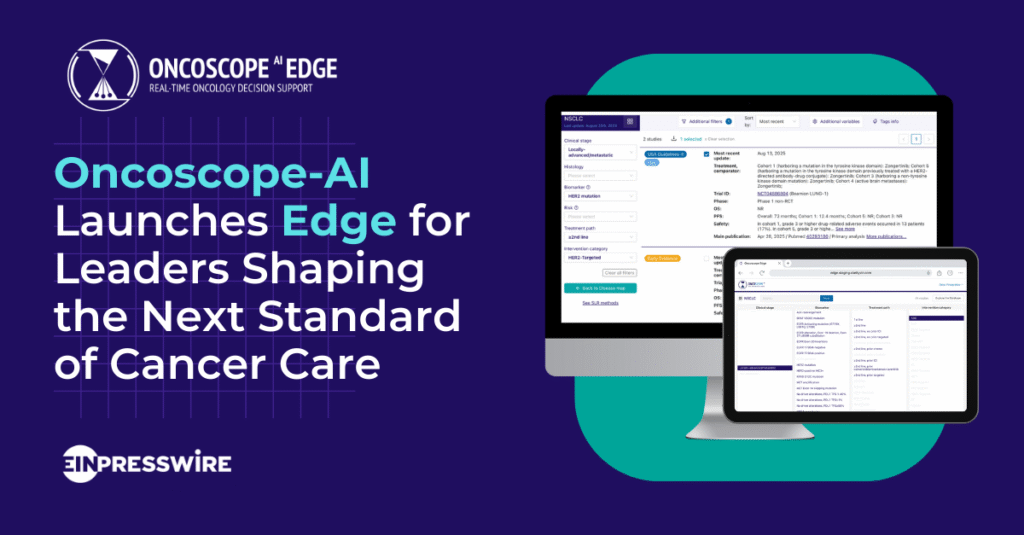
This press release was originally published to EINPresswire on 28 August 2025. NEW YORK, NY, UNITED STATES, August 28, 2025 /EINPresswire.com/ — Oncoscope-AI, a pioneer in real-time oncology evidence solutions, today announced the launch of Oncoscope Edge, a premium decision-support platform designed for oncology leaders and decision-makers who demand comprehensive, flexible, and actionable insights. In today’s fast-moving oncology landscape, specialists face an overwhelming volume of data—from thousands of new clinical trials to rapidly evolving guidelines and regulatory updates. Oncoscope Edge empowers oncologists, fellows-in-training, researchers, and educators with advanced tools to find, filter, and synthesize the evidence that matters most. “Oncoscope Edge is built for the leaders shaping the next standard of care,” said Anna Forsythe, PharmD, MBA, Founder and CEO of Oncoscope-AI. “Whether you are preparing for a congress talk, conducting a scientific project, guiding a tumor board, or training the next generation of oncologists, Edge delivers clarity from complexity—instantly.” Advanced Features of Oncoscope Edge include: With these capabilities, Oncoscope Edge goes beyond surface-level searches, available now in Oncology-AI’s Essential tool, to deliver deeper, customizable searches and user-generated reports—enabling oncology leaders to stay ahead in a field where evidence evolves daily. About Oncoscope-AI Oncoscope-AI is the first real-time oncology information platform integrating treatment data, guidelines, peer-reviewed publications, and regulatory approvals. By combining AI-powered systematic literature reviews with expert human validation, Oncoscope ensures that oncology decision-making is grounded in the most current and reliable evidence. Sign up for a free license key (verified health care professionals only) or to receive a demo.