
Why AI’s Biggest Blind Spot In Pharma Isn’t Technical

This article was originally published by Anna Forsythe in Forbes on 03 March 2026. I spend a lot of time working with artificial intelligence, and I am constantly struck by a contradiction: On one hand, AI has become remarkably fluent. It can summarize dense material, surface insights from massive datasets and produce text that looks confident enough to pass for expertise. On the other hand, in some of the places where accuracy matters most, AI remains almost entirely clueless about real decision making. Pharmaceutical evidence generation is one of those places. A Systemic Blind Spot Despite years of excitement about AI in healthcare, there are still no widely used systems that autonomously maintain living, submission-ready evidence for regulatory or reimbursement purposes. This is often framed as a technology gap. In my experience, it is much more than a gap; it is a systemic blind spot not easily remedied. It exposes a misunderstanding of what regulated evidence actually is and what today’s AI systems are built to do. Systematic literature reviews are not summaries. Nor are they answers to questions posed after the fact. They are strictly governed by carefully regulated processes. They begin with predefined protocols, require transparent inclusion and exclusion logic, and must withstand scrutiny long after the original analysis is complete. Regulators and payers do not just ask what conclusions were reached. They ask how those conclusions were formed, what was excluded along the way and whether the same decisions would be made again if the review were repeated. They need to understand how those decisions were made. This is where conversational AI systems struggle in ways that cannot be fixed with better prompts or larger models. Large language models are optimized for plausibility, not traceability. They are designed to produce likely responses, not to preserve the reasoning trail behind each decision. While they can describe evidence convincingly, they cannot reliably explain why one study mattered more than another, or why a marginal trial was excluded at a particular point in time. When the literature updates—as it constantly does in oncology—those inconsistencies compound. I have seen teams experiment with using chatbots to “speed up” evidence reviews, only to discover that what looks efficient at first quickly becomes indefensible under scrutiny. The problem is not that the chatbot models are unsophisticated. It is that the task itself—the special sauce behind the systematic literature review—is not generative in nature. That special sauce needs to be procedural, auditable and accountable. At the same time, the pressure to maintain living, constantly updated evidence has never been higher. Clinical data no longer arrives in neat cycles. New trials appear between guideline updates. Regulatory decisions shift comparators. Payers ask questions that did not exist when the original review was written. Static evidence simply cannot keep up. This has created a strange stalemate. Fully manual processes are too slow and resource-intensive. Fully automated ones are not trustworthy. Many organizations quietly accept the friction, even as they invest heavily in AI elsewhere. A Change In Design What ultimately breaks that stalemate is not better AI, but a different way of designing work. In regulated environments, the only approach that scales is human-in-the-loop intelligence. Machines do what they are good at—continuous surveillance, structured extraction, pattern detection—while humans retain ownership of judgment, interpretation and accountability. When designed properly, this does not slow teams down. But it does change where expertise is applied. What surprises many leaders is that this challenge is not unique to pharma. Several years ago, I had a conversation with an executive in commercial aviation who described a similar tension. Modern aircraft are astonishingly automated. They can take off, navigate complex airspace and land with minimal human input. Yet aviation has never tried to remove pilots from the cockpit. In fact, as automation has increased, pilot training has become more rigorous, not less. The reason is trust. When something goes wrong at 35,000 feet, no one accepts “the system thought it was likely” as an explanation. Automation is expected to assist, not absolve. Human oversight is not a fallback; it is part of the system’s credibility. Evidence generation works the same way. Regulators do not reject AI because it is new. They reject opacity. They expect to see where judgment was applied, and by whom. Systems that blur that boundary undermine trust, even if their outputs look impressive. What’s Holding Organizations Back? What ultimately holds organizations back from building these hybrid systems is rarely technology. It’s culture. Most companies are still organized around projects with defined endpoints, not living assets that require continuous stewardship. Evidence is treated as a document to be delivered, not an infrastructure to be maintained. AI initiatives are evaluated on novelty and visibility, not on whether they quietly reduce friction year after year. Changing that requires leadership restraint. It means resisting the temptation to deploy tools that demo well but cannot be defended later. It also means investing in governance, workflow redesign and cross-functional ownership—none of which make headlines, but all of which determine whether AI creates real value. The most important lesson I have learned working at the intersection of AI and regulated decision making is this: Fluency is not the same as reliability. The organizations that succeed with AI will not be the ones that generate the fastest answers, but the ones that can explain and stand behind those answers when it matters. In pharma, as in aviation, intelligence is only as valuable as the trust it earns. And that means human beings in the chain of command.
Pharma’s Biggest Missed AI Opportunity Is Living Evidence
This article was originally published by Anna Forsythe in Forbes on 29 January 2026. At this year’s J.P. Morgan Healthcare Conference, the largest healthcare investment symposium in the industry, it is no surprise that artificial intelligence featured prominently across a wide range of discussions from drug discovery, target identification and molecule design to clinical trial optimization and operational efficiency. AI applications are now fully embedded in each of these core pharmaceutical R&D strategies. What was far less visible, however, was the role AI could play in the systematic evaluation of scientific literature that underpins nearly every strategic, regulatory and reimbursement decision in modern pharma—or evidence generation. This omission is notable, in fact critical, at a time when AI-assisted evidence generation represents one of the industry’s most immediate and measurable opportunities for return on AI investment. Where AI Is Being Applied Today Current AI adoption in pharma tends to focus on highly visible areas closely associated with innovation, such as accelerating discovery timelines, improving trial execution and supporting internal productivity. These use cases already demonstrate long-term value and competitive differentiation. Still, the majority of high-stakes decisions in pharma do not hinge on discovery algorithms alone. Instead, they depend, as they have for decades, on structured assessments of existing evidence about disease burden and unmet need, historical endpoints and comparator performance, safety signals and evolving standards of care. These traditional assessments inform decisions ranging from trial design and asset valuation to regulatory strategy and pricing. Despite their importance, evidence workflows remain largely manual and highly fragmented. Navigating Using Outdated Maps A useful analogy is navigation. When trying to reach a destination, no one relies on an outdated static map (remember MapQuest?) printed years ago. Roads change, traffic patterns evolve and more efficient routes emerge constantly. Modern navigation relies on GPS systems that update continuously and reroute in real time. Pharma, however, still navigates critical decisions using static evidence reviews. Systematic Literature Reviews (SLRs), which have long been the gold standard for evidence synthesis, continue to be conducted as project-based exercises. This one-off approach is expensive and time-consuming, and the results are quickly outdated as new publications appear, guidelines are revised or new therapies enter the market. Once completed, these product-based exercises often live in disconnected siloes, requiring tweaking or partial reconstruction to support the next decision In a scientific environment that evolves daily, this reliance on static evidence is an increasingly poor and outdated solution, especially at a time when living, continuously updated maps offer a cost-effective solution. Increasing Regulatory And Reimbursement Pressure The limitations of static evidence are becoming more consequential as medical reimbursement systems evolve. In the United States, Medicare price negotiations are now in their third cycle under the Inflation Reduction Act. Medicare Part B drugs in oncology, for example, once largely insulated from pricing negotiations, are now fully in scope as of 2026. Manufacturers are expected to justify pricing not only based on evidence available at launch but also relative to new comparators and changing standards of care that continuously emerge over time. In Europe, the Joint Clinical Assessments (JCA), designed to create a unified, cross-national analysis of the efficacy of new drugs, raise needs and expectations further. Companies must consider all relevant comparators across all EU member states, address multiple subpopulations and present comprehensive, transparent evidence syntheses that can withstand scrutiny across multiple jurisdictions. In both settings, evidence is no longer assessed at a single point-in-time. At a time when regulatory and reimbursement demands are continuously being re-evaluated, conventional static snapshots struggle to keep pace with these demands as they evolve. The Cost Of Fragmentation Despite this pressure, evidence generation in pharma remains highly fragmented. Different functions (R&D, regulatory, health economics, market access, commercial) often commission their own literature reviews for similar questions. Reviews are modified, repeated and localized across regions, frequently by different external vendors and internal teams. Assumptions diverge. Institutional knowledge is lost. Redundancy accumulates. That redundancy is costly. A single high-quality SLR routinely costs six figures and takes months to complete. For global organizations with large portfolios, the cumulative cost of duplicated effort is substantial. More importantly, fragmented evidence increases the risk of inconsistency at moments when alignment matters most. Why General-Purpose AI Falls Short Generative AI tools like ChatGPT and chatbots are often cited as a solution. While useful for summarization or exploration, they are not designed to produce regulatory-grade evidence. Regulatory and reimbursement decisions require predefined methods, transparent inclusion criteria, traceable citations, reproducibility and alignment with established systematic review standards. Outputs must be auditable and defensible. General-purpose AI systems prioritize fluency over traceability and cannot replace structured evidence synthesis. In low-risk settings, speed may outweigh rigor. In regulated environments, rigor is non-negotiable. The Case For Living Evidence The alternative is a shift from static reviews to living evidence. A living evidence approach treats evidence as shared infrastructure rather than as a series of isolated projects. Evidence is continuously updated as new data emerges, centrally governed, and organized by indication, population, comparator and endpoint. Updates are incremental rather than repetitive, and changes are transparent. Functionally, this mirrors how GPS systems work: always current, responsive to new information and capable of supporting multiple routes and decisions from the same underlying map. Such an approach could support better decision-making across the product life cycle, reduce duplication and improve consistency under increasing regulatory and reimbursement scrutiny. Why The Shift Has Been Slow If the potential benefits are clear, why has adoption been limited? One reason is organizational structure. Evidence budgets are typically allocated by function, by brand and by project. Living evidence, by contrast, is shared longitudinally and is cross-functional. Adoption requires investment at an enterprise level rather than ownership by a single team. Living evidence is also, by its nature, less visible than discovery breakthroughs or novel technologies. Yet visibility and return are not the same. As AI continues to reshape pharma, the most impactful opportunities may lie not only in discovering new drugs faster, but in navigating the increasingly complex evidence landscape more intelligently. In an industry under growing pressure to
Oncoscope-AI Launches REAL-SLR library to Transform Oncology Evidence supporting Pharma R&D and Market Access Decisions
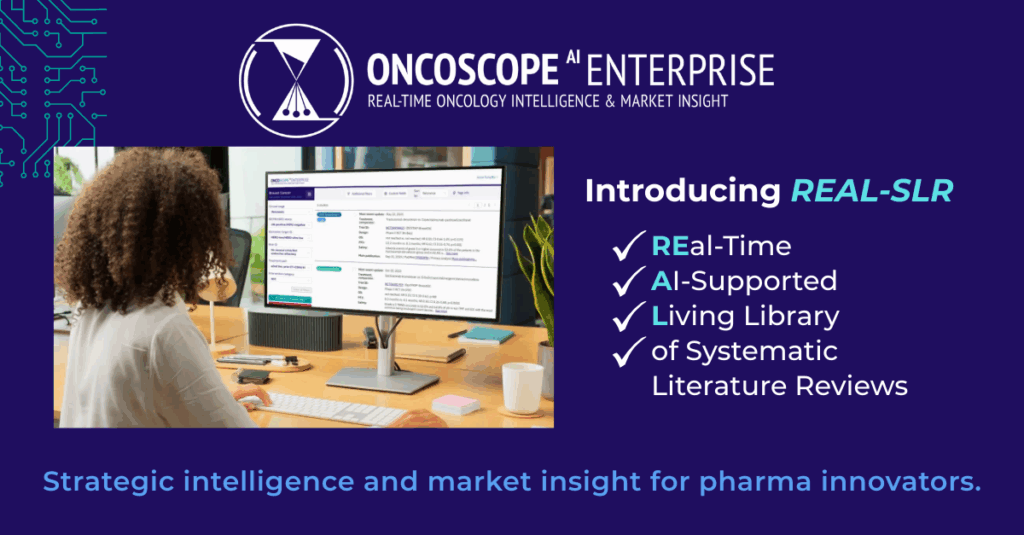
This press release was originally published to EINPresswire on 12 January 2026. Oncoscope launches the first Real-time, AI-supported Living Systematic Literature Review designed for enterprise-wide pharma use across R&D and commercial teams MIAMI, FL, UNITED STATES, January 12, 2026 /EINPresswire.com/ — Oncoscope-AI, a pioneer in real-time oncology evidence solutions, today announced the launch of Oncoscope Enterprise, a first-of-its-kind REAL-SLR (REal-Time, AI-Supported Living Systematic Literature Review) platform built to address one of pharma’s most persistent and costly challenges: keeping oncology evidence current, connected and usable across the product lifecycle. Pharmaceutical companies spend millions of dollars per asset conducting systematic literature reviews (SLRs) to support early development decisions, regulatory submissions, health technology assessments (HTA), pricing and reimbursement, and competitive intelligence. In oncology, where new trials, congress abstracts and regulatory actions are published daily, traditional static SLRs quickly become outdated—forcing teams to rerun searches, recreate reports and manage growing collections of disconnected evidence documents. Oncoscope Enterprise replaces this fragmented model with a continuously updated, regulatory- and HTA-grade living evidence library—built once, refreshed daily and reused across functions. A New Standard for Living Oncology Evidence At the core of Oncoscope Enterprise is Real-Time AI-assisted Living SLR (REAL-SLR) library, a new category of evidence infrastructure that goes beyond conventional SLR software or project-based reviews. Instead of producing static reports that rapidly lose relevance, REAL-SLR delivers a continuously evolving library of evidence foundation that supports strategic planning through post-launch decision-making. The platform enables cross-functional pharma teams to move seamlessly from early asset strategy and Target Product Profile development to clinical planning, regulatory submissions, HTA dossiers, market access strategy and ongoing competitive intelligence by using a single living source of continuously updated evidence.“Oncoscope Enterprise is designed as a “GPS for Oncology”—intuitive enough for medical affairs, commercial, and strategy teams, yet sufficiently rigorous for regulatory, HEOR and HTA use,” said Anna Forsythe, PharmD, MBA, MSc, Founder and CEO of Oncoscope-AI. “The platform requires no software training, no downloads and no specialized SLR expertise, enabling rapid enterprise-wide adoption. Designed for Enterprise-Wide Use Access is provided via annual enterprise subscriptions by tumor type. Users can rapidly navigate from high-level disease and line-of-therapy landscapes to individual trials, outcomes, and sub-populations in just a few clicks. Evidence can be filtered using PICO (Population, Intervention, Comparator, Outcomes) criteria, and further refined by biomarker, line of therapy, congress, or study characteristics.Four tumor types are currently available on the platform: non-small cell lung cancer, breast cancer, prostate cancer, and multiple myeloma, with additional launches planned this year for bladder cancer, chronic lymphocytic leukemia and pancreatic cancer. Submission-Ready Evidence, Without Rebuilding From Scratch Oncoscope Enterprise enables pharma teams to generate submission-ready, regulatory-grade HTA-aligned evidence outputs without repeatedly restarting literature searches or recreating reports. By reducing duplication of effort and eliminating repeated SLR rebuilds, the platform significantly shortens timelines and lowers the operational burden associated with evidence generation and maintenance. Key capabilities include: “Pharma teams are not short on data—they are short on evidence that is current, connected and reusable,” added Forsythe. “REAL-SLR changes the model entirely. Instead of rebuilding evidence every time the science moves forward, teams can work from a living foundation that evolves daily and supports decisions across the organization.” Proven at Scale In 2025, the Oncoscope-AI team systematically reviewed more than 72,000 oncology publications, supporting a growing community of over 4,500 registered oncology users in the US and EU. Key Features of Oncoscope REAL-SLR Include: What Is REAL-SLR? (Media Explainer) REAL-SLR (REal-Time, AI-Supported Living Systematic Literature Review) is a new approach to evidence generation designed for fast-moving therapeutic areas such as oncology. Traditional SLRs are static, project-based documents that must be recreated every time new evidence is published. REAL-SLR™ replaces this model with a continuously updated, living evidence library. REAL-SLR™ is defined by three core principles: About Oncoscope-AI Oncoscope-AI is an oncology-focused evidence intelligence company delivering real-time, living systematic literature reviews to support clinical, regulatory, HTA and market access decision-making. Its platforms combine AI-supported evidence synthesis with expert human validation to help healthcare and life sciences organizations navigate rapidly evolving oncology data with confidence. Visit us on social media: LinkedIn Instagram YouTube BlueSky X
The Market Access Podcast: Will AI and Living Reviews Define the Next Era of Health Care Market Access?

Oncoscope-AI Founder & CEO Anna Forsythe was recently on the Market Access Podcast with Dr. Stefan Walzer to discuss how Living Systematic Literature Reviews (Living SLRs) are redefining evidence generation in oncology and beyond – highlighting the power of real-time updates, advanced automation, and the essential role of human insight. Traditional SLRs are static snapshots, while Living SLRs are real-time, dynamic, and AI-powered—delivering continuously updated insights crucial for life-or-death decisions and payer evaluations. Join this discussion as they explore the myth of AI chatbots as true decision support tools, the need for actionable data over summaries, and the future of evidence synthesis, clinical decision-making, and smarter market access. Listen on Spotify: Listen on YouTube: Listen on PocketCasts: