
From Evidence To AI: Why The Future Of Oncology Decision Support Must Be Built On Living Evidence
This article was originally published in Forbes on 18 September 2025. How do oncologists decide which treatment to give their patients? It’s rarely an easy choice. Physicians must weigh multiple levels of information, such as the patient’s disease stage, genetic markers, previous therapies, overall health in general and even personal preferences. Then comes the quest for evidence. In order to validate the optimal way forward, oncologists need not only know what is effective, but also whether it is FDA-approved, guideline-adherent or available through a clinical trial. To find the best, most up-to-date information, that validation typically involves toggling between PubMed, society guidelines, journal notifications and conference summaries, and then rationalizing information that doesn’t always align. All of this is tedious and time-consuming. Time that most oncologists don’t have. In a high-volume clinic, a medical oncologist may see 30 to 50 patients in a day. But even with all of those time pressures, each and every decision should be made with the latest, most complete and scientifically valid evidence available. The stakes are high. With the mountain of new research and evidence published in oncology journals constantly expanding, evidence literally shifts by the day. Those shifts in evidence—the decisions between the right and wrong treatment—can be life or death. The Enduring Value Of Evidence Hierarchies Medicine has long recognized that not all evidence is created equal. A single case report may stimulate ideas, but it cannot guide practice. Observational studies provide associations but not certainty. Randomized controlled trials minimize bias and provide more insight. But at the very top of the hierarchy are systematic reviews and meta-analyses, which combine the entire weight of the evidence. This hierarchy matters because medicine is complicated. If we relied on anecdotes or headlines in isolation, patients would be subjected to treatments that look promising by themselves but prove ineffective or even counterproductive when considered in context. For this reason, organizations from the FDA to WHO mandate Systematic Literature Reviews (SLRs) when shaping guidelines, approvals and policies. Systematic reviews are the gold standard for evaluating medical evidence—the safety net for modern medicine. They prevent us from the risks of cherry-picking studies, overvaluing anecdotes or relying on unverified opinions. The Lure And Risk Of Chatbots Given the deluge of new medical information—and the tedium of just reading it all, let alone evaluating it—it’s no wonder that AI chatbots have captured attention. Faced with information overload, the idea of typing a quick question and receiving a fluent, confident paragraph or two is more than just appealing. It can be viewed as a lifeline for busy oncologists. But that’s where the danger lies. Chatbots don’t conduct systematic reviews. They can’t distinguish between high-quality trials and weak studies. They don’t verify whether a therapy is FDA-approved or buried in an outdated guideline. And in some cases, they even fabricate references, miss key data or rank that data inappropriately. Convenience can be seductive, but in oncology, where the margin for error is minute, the cost of error, or incomplete or inaccurate information, is disastrous. That convenience might be harmless if you’re asking Siri to find the nearest grocery store. But in cancer treatment, the right choice can extend life. The wrong choice can cut it short. Evidence Hierarchies Matter Everywhere The lesson extends well beyond oncology. In cardiology, guidelines for heart failure shift frequently. Missing an update could mean prescribing a less effective therapy. In infectious disease, choosing the wrong antibiotic fuels global resistance—making “tried and true” therapies less potent, and new approved therapies a better solution. Outside of medicine, the same principle holds true. Financial advisors trust portfolio strategies grounded in decades of cumulative analysis, not a single trader’s hunch. Aviation safety regulations are shaped by the aggregation of countless investigations, not anecdotal exceptions. Across industries, systematic, comprehensive evidence beats selective inputs every time. From Static Reviews To Living Evidence If chatbots aren’t the solution, then what is? The answer lies in bringing evidence hierarchies into the era of AI. Imagine a living systematic review in real-time, providing a comprehensive, up-to-date synthesis of the evidence—backed by AI and vetted by humans. Instead of replacing systematic reviews, AI in this new paradigm augments them. Algorithms filter through the sheer volume of new publications, screen for relevance, raise quality issues and update evidence maps in real time. And then experts evaluate the results before they reach the physician’s desktop. This model is rigorous yet addresses medicine’s biggest bottleneck—time. Doctors would no longer be forced to sort through hundreds of studies manually. Instead, they would access a dynamic, physician-ready summary rooted in the totality of evidence. AI does the heavy lifting of scanning and sorting, while human experts remain the arbiters of interpretation. A Human-AI Partnership This combination is the future that I am dedicated to and the foundation of the work that my team is producing. At Oncoscope, we don’t rely on generative AI to spin out answers. Instead, we use a suite of AI models to reproduce and accelerate the standardized steps of a systematic review. Think of it like a symphony. AI can tune the instruments, arrange the sheet music and keep the score updated in real time. But only the conductor—the oncologist—can interpret the music for the audience. This collaboration leverages each party’s strength: Machines are better at speed and repetition, while humans are better at judgment and context. The end product is evidence, both thorough and up-to-date, that doesn’t overwhelm the clinicians who need to implement it. Why Caution Matters Now The enthusiasm around AI in healthcare is understandable. Physicians are busy, patients are better informed than ever and the pace of discovery keeps accelerating. But in our rush to adopt new technology, we risk abandoning the very safeguards that make modern medicine safe. It would be unthinkable to prescribe chemotherapy based on a single press release, yet we risk doing something similar if we accept unverified chatbot outputs at face value. In oncology, where decisions can never be undone, shortcuts are dangerous. Archibald Cochrane, the father
The Healthy Enterprise Podcast: AI’s Role in Modern Oncology – A New Era of Evidence-Based Cancer Care

Our very own Founder & CEO Anna Forsythe was recently on The Healthy Enterprise podcast to talk about Oncoscope-AI and how our practice-changing platform delivers real-time treatment insights, clinical guidelines, and research to support oncologists in an ever-evolving cancer landscape. Watch on YouTube: Listen on Spotify: Listen on Pocket Casts: From The Healthy Enterprise Podcast: In this episode of The Healthy Enterprise, Anna Forsythe, founder and CEO of Oncoscope-AI, shares her journey from manually processing oncology data to creating an AI-powered platform that delivers real-time treatment insights, clinical guidelines, and research to support oncologists in an ever-evolving cancer landscape. She discusses the importance of reliable evidence in decision-making, the positive response from physicians using the free platform, and the role of systematic data reviews in building trust and efficiency. Beyond the technology, Anna reflects on her entrepreneurial path, the challenges and opportunities of leading in healthcare, and the importance of cultivating talent, mission-driven culture, and visionary leadership. The conversation concludes with her insights on business models, community impact, and the future of AI in advancing cancer care. Chapters: 00:00 Introduction to Oncoscope-AI and Anna Forsythe03:04 The Need for Real-Time Oncology Data05:59 Transitioning from Manual to Automated Data Processing09:11 The Role of AI in Oncology12:13 Feedback and Response from Healthcare Professionals14:45 Data Sources and Systematic Reviews in Oncology18:02 Future Developments and Expanding Services21:53 AI in Research: Balancing Trust and Efficiency25:52 Business Model and Revenue Streams29:44 Personal Journey and Altruism in Business32:56 Challenges and Opportunities in Healthcare35:34 Leadership and Team Dynamics39:29 Visionary Leadership and Future Aspirations Guest Information: Takeaways: Keywords: Oncology, AI, healthcare, data processing, clinical guidelines, cancer treatment, healthcare technology, real-time data, systematic reviews, healthcare professionals, AI, healthcare, business model, cancer treatment, research, leadership, altruism, revenue streams, technology, innovation Enjoy this clip from the episode:
From Cochrane to Chatbots: Have We Forgotten the Evidence?
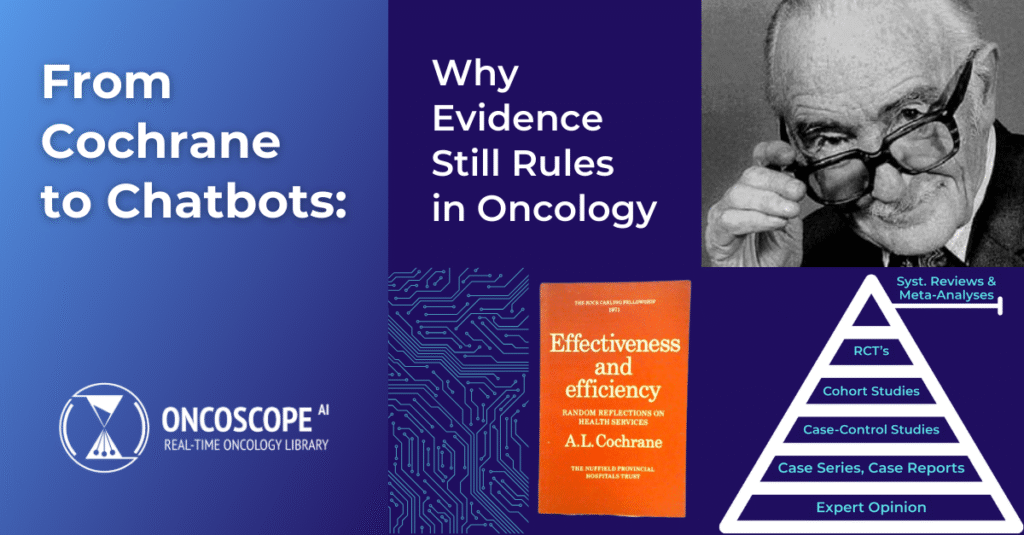
If medicine had a godfather of evidence, his name would be Archie. Archibald Leman Cochrane, that is. Cochrane wasn’t just a physician—he was a rebel against tradition. In the 1970s, he looked around at the medical world and said, essentially: “Too much of what we do is based on habit and authority, not actual proof.” He proposed a radical idea: let’s rank evidence by reliability. At the bottom sat case reports and expert opinions—interesting, but hardly solid. Above that came observational studies, then randomized controlled trials (RCTs). And sitting proudly at the top of the pyramid? Systematic literature reviews (SLRs): structured evaluations that capture all the studies, critique their quality, and synthesize their findings. That hierarchy became the foundation of what we now call Evidence-Based Medicine (EBM). Why Systematic Reviews Matter Systematic reviews aren’t academic busywork. They’re the reason guidelines from the World Health Organization, NICE, and the American Society of Clinical Oncology (ASCO) are trustworthy. They’re why the FDA demands comprehensive, systematic evidence before approving a therapy. The principle is simple: no single trial tells the full story, but when you put the whole picture together—carefully, transparently, reproducibly—you can make decisions that change lives. But Have We Forgotten Cochrane? Fast forward to today. AI chatbots can answer clinical questions in seconds. They sound authoritative, but they don’t follow Cochrane’s hierarchy. They don’t systematically review literature. They don’t grade evidence for quality. And they definitely don’t show their work. In oncology, where new studies are published daily, this is not a minor issue. A chatbot that casually cites one study—or worse, invents a citation—could mislead a physician into recommending something harmful, or missing a life-saving option. It’s like we built the evidence pyramid over decades, and now, dazzled by shiny AI, we’re forgetting why we built it in the first place. The Way Forward The future of evidence isn’t abandoning systematic reviews. It’s making them living: constantly updated, rigorous, and transparent. AI does have a role to play here—not as a chatbot dispensing unverified answers, but as a tool that accelerates and augments systematic reviews. That’s exactly what we’re building at Oncoscope: living SLRs, human-vetted and PhD-curated, augmented by AI. Reliable, current, and ready to support the most important decisions in oncology. Because in cancer care, evidence isn’t an academic debate. It’s a matter of life, harm, or hope. So the question is: are we going to let chatbots distract us from Cochrane’s lesson—or use AI to fulfill it? Anna Forsythe is the Founder and President of Oncoscope-AI, the first platform to bring together real-time oncology treatment data, clinical guidelines, research publications, and regulatory approvals — all in one place, just like Expedia for cancer care. Available free to oncology professionals worldwide, Oncoscope-AI is redefining how cancer care information is accessed and applied. A clinically trained Doctor of Pharmacy (PharmD), Anna also holds a Master’s in Health Economics and Policy from the University of Birmingham (UK) and an MBA from Columbia University. She previously co-founded Purple Squirrel Economics (acquired by Cytel in 2020) and led Global Value and Access at Eisai Pharmaceuticals, following earlier roles at Novartis and Bayer in clinical research and health economics.