
Oncoscope-AI Launches Edge for Leaders Shaping the Next Standard of Cancer Care
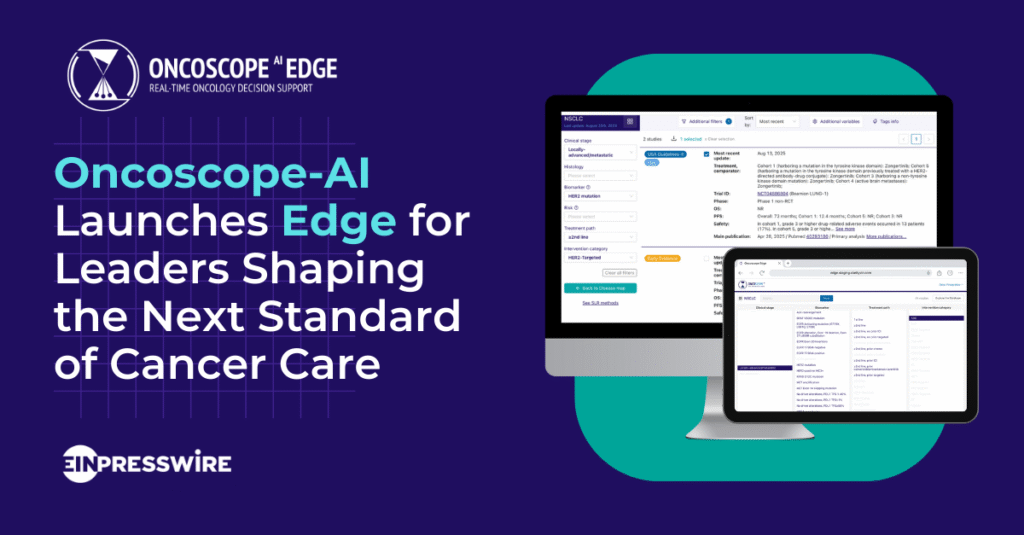
This press release was originally published to EINPresswire on 28 August 2025. NEW YORK, NY, UNITED STATES, August 28, 2025 /EINPresswire.com/ — Oncoscope-AI, a pioneer in real-time oncology evidence solutions, today announced the launch of Oncoscope Edge, a premium decision-support platform designed for oncology leaders and decision-makers who demand comprehensive, flexible, and actionable insights. In today’s fast-moving oncology landscape, specialists face an overwhelming volume of data—from thousands of new clinical trials to rapidly evolving guidelines and regulatory updates. Oncoscope Edge empowers oncologists, fellows-in-training, researchers, and educators with advanced tools to find, filter, and synthesize the evidence that matters most. “Oncoscope Edge is built for the leaders shaping the next standard of care,” said Anna Forsythe, PharmD, MBA, Founder and CEO of Oncoscope-AI. “Whether you are preparing for a congress talk, conducting a scientific project, guiding a tumor board, or training the next generation of oncologists, Edge delivers clarity from complexity—instantly.” Advanced Features of Oncoscope Edge include: With these capabilities, Oncoscope Edge goes beyond surface-level searches, available now in Oncology-AI’s Essential tool, to deliver deeper, customizable searches and user-generated reports—enabling oncology leaders to stay ahead in a field where evidence evolves daily. About Oncoscope-AI Oncoscope-AI is the first real-time oncology information platform integrating treatment data, guidelines, peer-reviewed publications, and regulatory approvals. By combining AI-powered systematic literature reviews with expert human validation, Oncoscope ensures that oncology decision-making is grounded in the most current and reliable evidence. Sign up for a free license key (verified health care professionals only) or to receive a demo.
Why an AI Chatbot Can’t Replace a Systematic Literature Review — and What It Can Do
In a world where AI is evolving rapidly, one question keeps coming up in healthcare, especially in evidence generation and market access: “Can an AI chatbot replace a systematic literature review (SLR)?” As the founder of Oncoscope-AI, a platform focused on transforming how we track and synthesize oncology evidence, my answer is simple: No — not even close. But there’s a much more important follow-up: AI can fundamentally transform how SLRs are built, maintained, and used — if we apply it the right way. Why SLRs Are Still the Gold Standard Systematic literature reviews are foundational tools in evidence-based medicine. They are methodologically rigorous, reproducible, and transparent — all critical features when informing high-stakes decisions in drug development, health technology assessments (HTAs), clinical guidelines, and reimbursement. A well-conducted SLR isn’t just a literature search. It’s a structured, protocol-driven process governed by frameworks like PRISMA, Cochrane, or GRADE. It includes clear inclusion/exclusion criteria, detailed documentation of search strategies, dual reviewer consensus, and often a meta-analysis. In short: SLRs build trust — because the process is as important as the outcome. Where AI Chatbots Fall Short While chatbots like ChatGPT, OpenEvidence, Perplexity, or other LLM-based tools can sound authoritative and answer questions quickly, they have significant limitations when it comes to replacing SLRs. These characteristics make them fundamentally incompatible with the standards required in clinical research, regulatory decision-making, or payer engagement. What AI Can Do for Evidence Synthesis While chatbots can’t replace SLRs, AI can absolutely enhance the way SLRs are performed, maintained, and consumed. This is the space we are focused on at Oncoscope-AI. Here’s how: 1. Real-Time Monitoring of New EvidenceAI can continuously scan new publications, clinical trial databases, regulatory announcements, and guideline updates — surfacing relevant changes in near real-time. 2. Efficient Screening and CategorizationAI can rapidly identify and classify articles based on criteria defined in a protocol, dramatically reducing the manual burden on human reviewers. At Oncoscope, we trained and validated AI programs to deliver over 99% accuracy for this task – with details on rejections well beyond what humans are used to provide. 3. Smarter Data ExtractionWhile AI can’t yet extract all types of data reliably, there are many variables where it already performs as well as — or even better than — humans. At Oncoscope, we carefully evaluate each type of data we need to extract, and we implement AI selectively and responsibly. The rule of thumb we follow is: if you can standardize it, you can automate it. Structured variables can often be automated — freeing our experts to focus on the more complex and nuanced interpretation. 4. Version Control and Living UpdatesTraditional SLRs are static snapshots. At Oncoscope, we’re enabling “Living SLRs” — always current, always linked to their sources, and always grounded in rigorous methods. 5. Actionable Summaries Without Compromising RigorUsing AI for extraction and summarization doesn’t mean cutting corners. It means scaling expertise, speeding updates, and freeing time for deeper interpretation. Our Vision at Oncoscope-AI We are not building another chatbot. We are building an evidence engine that understands how oncology evolves — one that stays current without sacrificing standards. Our platform continuously tracks: All of this is structured, sourced, and updated in real time — providing oncologists and other healthcare professionals with a living map of the oncology evidence landscape. In short, we’re bringing the structure of an SLR and the speed of AI together — without compromising either. Final Thoughts So, can an AI chatbot replace a systematic literature review? No — and it shouldn’t. But AI, when designed for evidence integrity and real-world utility, can transform what an SLR can become. This transformation is no longer hypothetical. It’s happening now — and we’re proud to be leading it at Oncoscope-AI. Interested in how a Living SLR can support your work in oncology or market access? Let’s connect.📩 info@oncoscope-ai.com | LinkedIn Anna Forsythe is the Founder and President of Oncoscope-AI, the first platform to bring together real-time oncology treatment data, clinical guidelines, research publications, and regulatory approvals — all in one place, just like Expedia for cancer care. Available free to oncology professionals worldwide, Oncoscope-AI is redefining how cancer care information is accessed and applied. A clinically trained Doctor of Pharmacy (PharmD), Anna also holds a Master’s in Health Economics and Policy from the University of Birmingham (UK) and an MBA from Columbia University. She previously co-founded Purple Squirrel Economics (acquired by Cytel in 2020) and led Global Value and Access at Eisai Pharmaceuticals, following earlier roles at Novartis and Bayer in clinical research and health economics.